
www.agritechmag.com
02
'26
Written on Modified on
Sunward SWCP6A completes first cotton harvesting trial in Brazil
The six-row cotton picker baler achieved over 95% picking efficiency and a 100% qualified bale rate, supporting Sunward’s South American expansion.
www.sunwardmachine.com
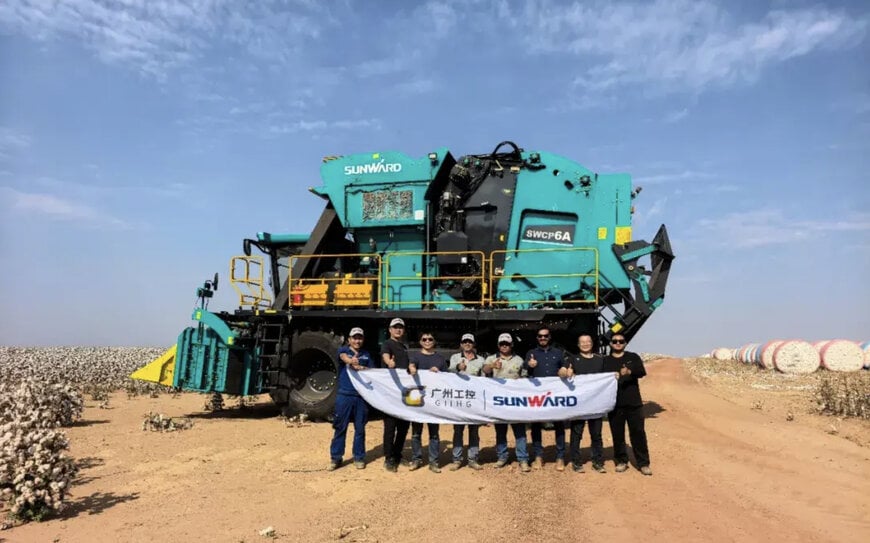
Large-scale industrial cotton farming requires rapid, weather-sensitive harvesting methods to protect fiber quality and minimize ground loss. Sunward Intelligent Equipment Co., Ltd. introduced its SWCP6A six-row self-propelled cotton picker baler to the South American agricultural market through structured field trials on a commercial farm in Mato Grosso, Brazil, demonstrating automated picking, onboard baling, and localized mechanical adaptation.
Operating Mechanisms and Harvesting Architecture
Industrial cotton harvesting equipment must balance mechanical extraction speed with fiber integrity to reduce seed-cotton trash content. The Sunward SWCP6A integrates harvesting and continuous packaging into a single mobile platform designed for large-scale cotton fields and agricultural cooperatives. Powered by a high-output diesel engine built onto a self-propelled chassis, the machine processes six rows of cotton simultaneously.
The front harvesting section relies on specialized picking heads equipped with engineered spindles and aerodynamic air ducts. Rotating spindles physically engage and extract the mature seed cotton from open bolls, while the internal pneumatic ducting conveys the loose fibers directly into the onboard processing chamber. This direct pneumatic conveyance minimizes mechanical friction and fiber degradation before the material reaches the compression mechanism.
Field Performance Metrics and Fuel Efficiency
During field trials initiated in late August and concluded in early September, engineering teams evaluated mechanical reliability, harvesting quality, and localized engine performance. Machine telemetry and post-harvest sampling documented a picking rate exceeding 95 percent, while maintaining a seed-cotton trash content below 8 percent.
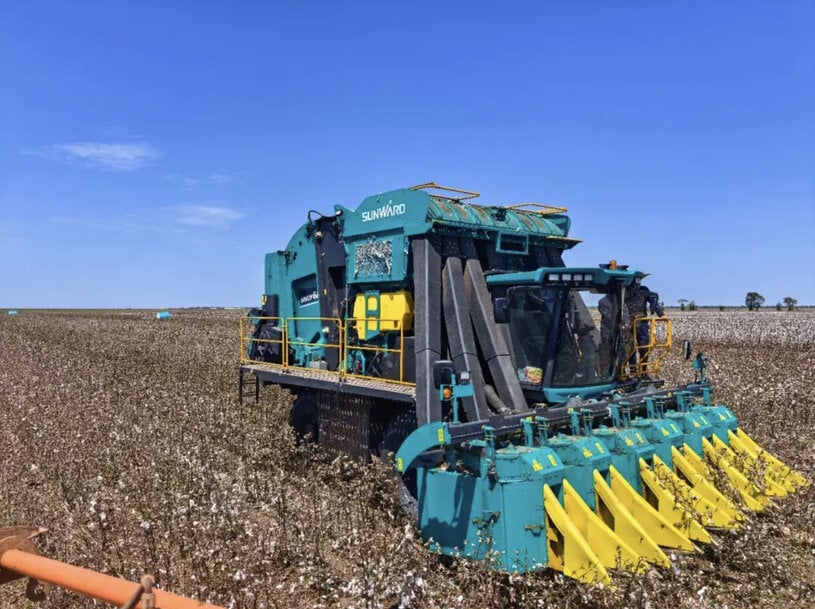
The onboard baling unit converts loose cotton directly into uniform bales within the field, achieving a 100 percent qualified baling rate during the operational phase. By packaging the cotton immediately behind the picking mechanism, the system removes the necessity for intermediate boll buggies and secondary field-side baling stations, lowering mechanical handling stages and preventing transport-related fiber drop. Field operational monitoring established a combined fuel consumption figure of approximately 2.0 liters per mu (approximately 30 liters per hectare) under continuous operation.
In-Cabin Telematics and Machine Control
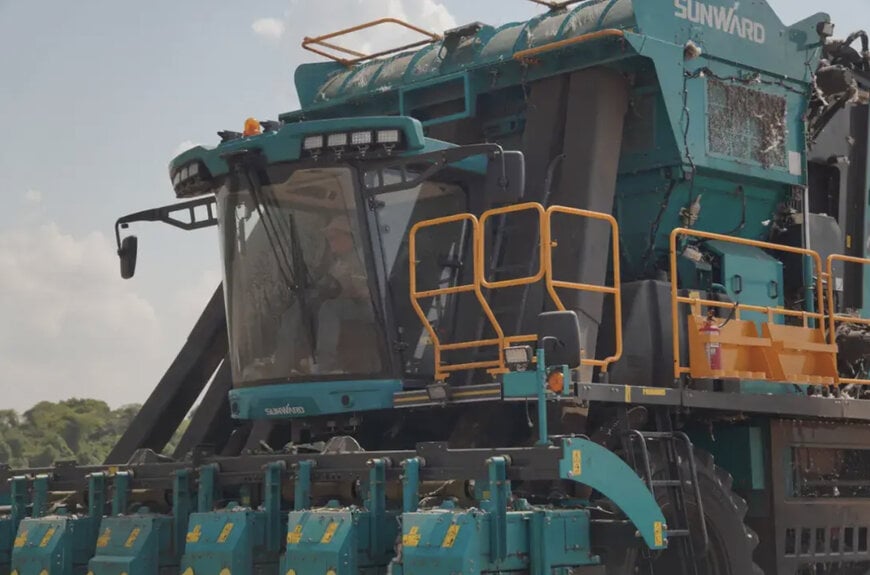
To maintain consistent picking quality across variable plant densities, the platform incorporates an electronic monitoring and control architecture. In-cab systems continuously monitor harvesting status, tracking real-time operational parameters, mechanical anomalies, and automated fault alarms.
The field trials were executed by local Brazilian machinery operators to assess human-machine interface ergonomics and control response under standard farm operating protocols. Field engineers from Sunward calibrated operational settings in response to local crop moisture levels and Brazilian row-spacing conditions, verifying that field diagnostics and parameter adjustments could be managed without factory engineering intervention.
Integration in Large-Scale Industrial Workflows
Mechanized harvesting represents a critical operational bottleneck in modern precision agriculture. In high-acreage environments, such as Brazil and Australia, standard harvesting setups historically relied on separate basket-style pickers that dumped seed cotton into tractor-pulled boll buggies, which subsequently transported the material to stationary hydraulic module builders.
Integrated picker-baler architectures combine these segmented steps into a continuous flow. The self-contained unit harvests, compresses, wraps, and ejects weather-resistant round or square bales directly onto the field surface without stopping forward motion. This workflow reduces field soil compaction by eliminating support tractor traffic and protects the harvested lint from seasonal rain exposure prior to gin delivery.
Additional Context:
This section details technical specifications and competitive benchmarking not included in the original product announcement.
Global industrial cotton harvesting has transitioned toward onboard round baling technology, historically driven by platforms such as the John Deere CP690 and CP770, as well as Case IH Module Express systems. Industry benchmarks for mechanized spindle pickers define optimal performance as achieving clean harvest recovery rates above 95 percent with seed-cotton foreign matter kept below 10 percent prior to industrial ginning. Modern high-capacity systems typically utilize six-row row units with variable-frequency spindle drives to match vehicle ground speed, which commonly ranges between 4.0 and 7.0 km/h during active picking.
Agricultural emissions and fuel benchmarks in this equipment category target consumption between 25 and 35 liters per hectare depending on crop density and topography. Standard wrapped modules protect fiber quality according to industry testing criteria established by bodies such as the International Cotton Advisory Committee (ICAC), which emphasize mitigating plastic wrap contamination and ambient moisture ingress during storage. As global cotton production hubs increasingly face labor limitations, continuous-baling six-row platforms remain the primary machinery standard for industrial broadacre production across South America, North America, and Australia.
Edited by Natania Lyngdoh, Induportals editor, with AI assistance.
www.sunwardmachine.com
