
www.agritechmag.com
29
'26
Written on Modified on
CLAAS Targets Lower Harvesting Costs with JAGUAR 1000 Upgrades
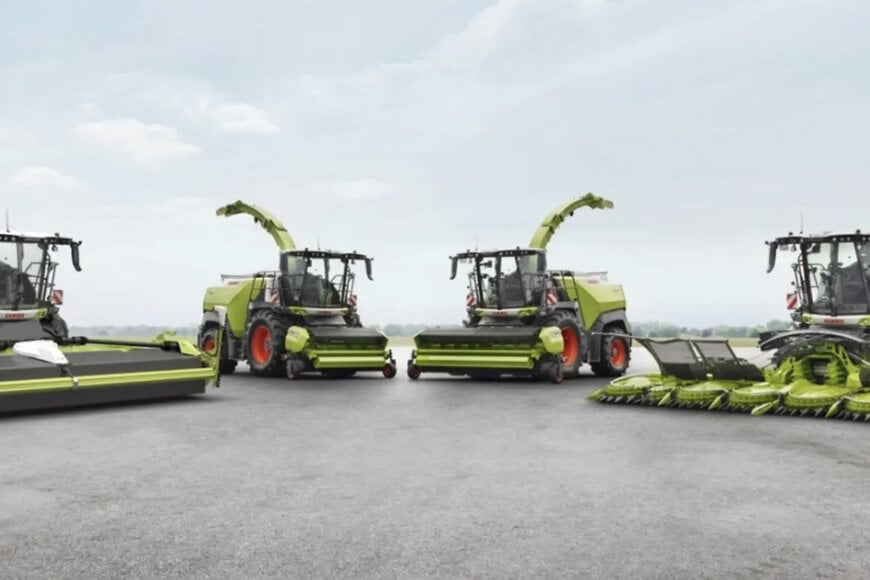
CLAAS introduces automated blade monitoring, live yield mapping and expanded nutrient analysis to improve harvesting efficiency, alongside the series launch of two new headers.
www.claas.com
Maintaining precise cutting geometry on forage harvester cylinders is critical for minimizing specific fuel consumption and preventing fiber fraying during crop processing. Uneven or dull knives increase the mechanical power required by the chopping cylinder, leading to accelerated wear and elevated thermal loads. To eliminate fixed-interval sharpening routines, CLAAS has expanded the availability of the CEMOS AUTO KNIFE CONDITION system from the Jaguar 900 series to the Jaguar 1000 series for 2027.
The system utilizes two reluctance sensors positioned above the chopping cylinder, entirely outside the primary material flow. These sensors emit a static magnetic field to measure blade geometry and wear across the entire working width of the cylinder. Operators configure the target sharpness profile and sharpening frequency via the in-cab CEBIS terminal. Rather than executing scheduled grinds, the software triggers sharpening sequences dynamically based on actual wear rates, which vary according to soil contamination and crop abrasiveness. This feedback loop preserves optimum cutting performance, reduces energy losses, and logs wear metrics directly into CLAAS connect for fleet management and service verification.
Real-Time Spatial Yield Mapping
Precise agronomic documentation requires continuous synchronization of mass flow sensors, moisture meters, and positioning data. The integration of live yield mapping via the GPS PILOT CEMIS 1200 terminal allows operators of the Jaguar 1000 to monitor four primary process parameters simultaneously: fresh weight yield per unit area, optimal moisture content, dry matter yield per unit area, and percentage dry matter content. Up to three of these metrics can be rendered concurrently as a live spatial map on the in-cab display or transmitted via cellular connection to mobile devices running CLAAS connect. Data synchronization occurs automatically within active job files, supporting export via TASKDATA standards for external farm management information systems.
Expanded Sensor Range for Organic Nutrient Application
The second-generation NUTRIMETER, initially introduced for dry matter and constituent analysis on the Jaguar 1000, now incorporates expanded measurement capabilities for organic fertilizer management. Operating as a mobile ISOBUS near-infrared (NIR) spectrometer, the device measures total nitrogen, ammonium nitrogen, potassium, phosphorus, and sulfur concentrations in real time during the application of liquid manure and fermentation digestate.
The sensor interfaces with slurry application equipment from manufacturers including Garant-Kotte, Samson, Kaweko, Fliegl, Wienhoff, and Zunhammer. Analytical data is rendered on the machine terminal, tractor ISOBUS interface, and remote office terminals, allowing agricultural contractors and farms to generate detailed nutrient balance logs for regulatory compliance and billing purposes.
Active Ejection Chute Stabilization
High-capacity forage harvesting at forward speeds across uneven terrain induces dynamic oscillations in the discharge assembly, complicating accurate material transfer into parallel transport vehicles. The Jaguar 1000 addresses this mechanical challenge through standard-equipment active vibration damping on the ejection elbow.
An algorithmic control loop processes real-time inputs from an angle sensor on the chute height, a gyroscope, and a hydraulic pressure sensor mounted on the lift cylinder. The system actively modulates hydraulic counter-pressure to offset vertical accelerations and structural flexing. This stabilization keeps the crop stream aligned with the designated target zone on transport trailers during overhead loading and cross-row harvesting, reducing operator fatigue and optimizing the performance of the AUTO FILL automated filling system.
Series Production of High-Capacity Headers
Following limited pre-production deployment during the 2026 harvest, full series production is now underway for the 16-row ORBIS 12000 maize header and the DIRECT DISC 8400 direct-cut header.
The ORBIS 12000 features a 12-meter working width, matching 16 rows at a 75 cm spacing to optimize the output capacity of the Jaguar 1000 power classes ranging from 850 to 1,110 PS. Independent drives for cutter discs, conveyor discs, and feed drums ensure consistent crop acceleration. The CEMOS AUTO HEADER system automatically modulates feed disc speeds relative to chop length and throughput, while the AUTO CONTOUR system utilizes three ground-contour sensors and dual active stabilizer wheels to maintain precise cutting heights across variable topography. Folded via a symmetrical transport mechanism, the unit maintains an external road transport width below 3.30 meters.
The DIRECT DISC 8400 offers an 8.41-meter working width for whole-crop silage harvesting up to 4.50 meters in height. It employs dual 4.20-meter MAX CUT cutter bars operating at a disc speed of 3,200 rpm, protected by individual SAFETY LINK overload modules. A hydraulically adjustable roller press governs material entry into the 800 mm feed roller assembly, ensuring steady crop flow into the pre-compression unit.
Additional Context:
This section details technical specifications and competitive benchmarking not included in the original product announcement.
The introduction of automated knife condition monitoring systems represents a shift toward condition-based maintenance in self-propelled forage harvesters, contrasting with traditional manual inspection intervals dictated by operational hours. Similarly, the expansion of mobile NIR sensing on application equipment aligns with tightening European regulatory frameworks governing nutrient management, where precise documentation of organic nitrogen and phosphorus application is legally mandated to prevent diffuse water pollution. In terms of header capacity, the 12-meter working width of the ORBIS 12000 places it among the widest front-end attachments available for high-horsepower forage harvesters, directly addressing transport logistics by reducing field travel distance compared to conventional 9-meter and 10.5-meter configurations.
Edited by Sucithra Mani, Induportals editor – adapted by AI.
www.claas.com
