
www.agritechmag.com
08
'26
Written on Modified on
Industrial Ammonia Synthesis Technology for Fertilizer Plants
KBR licenses proprietary Purifier ammonia process technology to Pampa Energia and SABIC for high-capacity regional fertilizer production facilities.
www.kbr.com
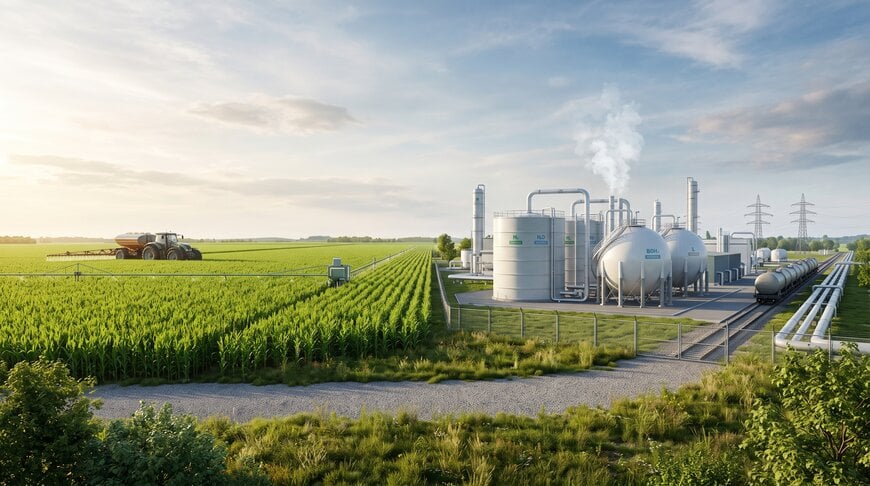
KBR has entered agreements with Pampa Energia and SABIC to deploy licensed ammonia synthesis technology in Argentina and Saudi Arabia. The initiatives address global agricultural nutrient supply through single-train ammonia and urea manufacturing infrastructure.
Technical Solution and Process Responsibilities
KBR provides the technology licensing, basic engineering design, and proprietary synthesis loops, including the Purifier and PurifierPlus processes. The Purifier architecture removes excess methane, argon, and residual impurities from synthesis gas via cryogenic purification before the gas enters the catalytic ammonia converter. This mechanism lowers loop operating pressure, extends catalyst service life, and reduces energy consumption compared to conventional reforming sequences.
Client operators manage plant construction, local feed gas supply, and subsequent plant operations. In Argentina, Pampa Energia is developing a facility specified at 3,430 metric tons per day of ammonia and 6,000 metric tons per day of urea. In Saudi Arabia, SABIC is deploying the technology for the San 7 complex, designed for 3,500 metric tons per day of ammonia and 8,000 metric tons per day of urea.
Industrial Scale and Operational Integration
The high-volume chemical synthesis plants convert hydrocarbon feedstocks into anhydrous ammonia (NH3) to serve downstream urea granulation units. Single-train synthesis designs minimize mechanical footprint, piping complexity, and capital expenditures while optimizing thermal integration across reforming, heat recovery, and synthesis compression stages.
Process stability benchmarks established by recent KBR licensees include commissioning within 10 days of hydrocarbon introduction followed by rapid ramp-up to design capacity, maintaining continuous conversion efficiency without catalyst degradation.
Agricultural and Chemical Sector Applications
Ammonia represents the primary reactive nitrogen carrier for commercial fertilizers, including urea, ammonium nitrate, and diammonium phosphate. Industrial synthetic ammonia accounts for approximately 80 percent of global demand, directly supporting crop yields for global food supply.
In addition to agricultural soil nutrition, ammonia produced by these facilities provides intermediate feedstocks for industrial polymers, including synthetic nylon and rayon fibres, and serves as an energy carrier for hydrogen distribution.
Production Capacity and Infrastructure Impact
The deployments establish the largest single-train ammonia production facilities within Latin America and the Middle East and Africa regions. The operational capacity of each plant provides fertilizer production sufficient to meet crop nutritional requirements for over 40 million people. The integration of high-pressure catalytic reforming with cryogenic synthesis gas purification provides continuous synthesis volume to meet projected global demand expansions, which are forecast to rise from 200 million metric tons per annum in 2024 to over 300 million metric tons per annum by 2040.
Edited by Evgeny Churilov, Induportals Media - Adapted by AI.
www.kbr.com
