
www.agritechmag.com
23
'26
Written on Modified on
Standardized Accounting Frameworks for Diversified Agricultural Carbon Markets
Regrow Ag outlines structural requirements for multi-channel environmental investment using unified measurement infrastructure to stabilize agricultural carbon market demand.
www.regrow.ag

Regrow Ag has detailed architectural recommendations for the European Union Carbon Removals and Carbon Farming Regulation (CRCF), proposing a shared measurement infrastructure to align corporate Scope 3 supply chain programs with emerging compliance frameworks. The technical approach targets the agri-food and land-management sectors, providing unified digital quantification to support diversified revenue streams across public incentives, sustainability-linked finance, and regulated carbon mechanisms.
Alignment of Multi-Tier Demand Signals in Carbon Farming
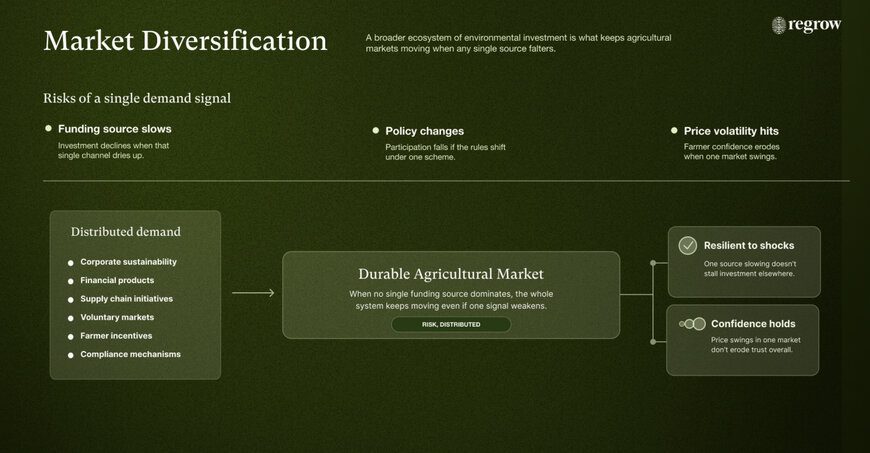
Agricultural decarbonization and soil carbon sequestration operate across complex agronomic systems where isolated commercial pathways fail to capture aggregate environmental value. As the European Union advances implementation of the CRCF, the primary operational challenge centers on establishing predictable, long-term market demand. Relying on a single demand vector creates structural volatility. If voluntary credit purchasing contracts, capital flows decline; if public policy priorities shift, land-manager enrollment drops; and if private secondary markets encounter price fluctuations, producer participation weakens.
Durable market structures distribute economic exposure across multiple financial sources. While voluntary carbon markets provide necessary testing environments for nascent quantification methodologies and deploy initial risk capital, systemic transformation requires binding regulatory targets. Long-term market durability relies on coupling corporate Scope 3 value-chain investments with compliance-driven obligations under unified governance.
Shared Measurement Architecture and Multi-Outcome Attribution
Agronomic interventions yield simultaneous, multi-variable outcomes across field environments. An operational transition—such as integrating cover crops, reducing tillage intensity, or optimizing nitrogen inputs—concomitantly enhances crop yield stability, lowers synthetic fertilizer expenditure, builds drought tolerance, and generates verifiable biogenic carbon sequestration alongside greenhouse gas mitigation.
Treating each outcome as an isolated asset creates redundant administrative requirements and escalating transaction costs. In the absence of a harmonized accounting standard, individual procurement programs, government subsidy systems, and voluntary registries establish proprietary reporting methodologies. This fragmentation impairs cross-market auditability. The CRCF framework offers the technical mechanism to establish a shared computational baseline. By standardizing primary data ingest, biogeochemical simulation parameters, and spatial boundaries, a single empirical data layer can underpin corporate greenhouse gas reporting, sustainability-linked loan covenant verification, and compliance-grade credit issuance while preventing double counting and secondary attribution errors.
Risk Mitigation Through Multi-Channel Capital Allocation
A diversified capital stack strengthens commercial stability for land managers and institutional investors. Food and beverage corporations deploy capital to secure agricultural supply-chain resilience and achieve science-based Scope 3 reduction milestones. Commercial financial institutions require standardized environmental risk data to underwrite sustainability-linked debt instruments. Concurrently, public agencies deploy incentive payments to safeguard regional water quality and biodiversity, while anticipated compliance platforms enforce legally binding removal mandates.
These diverse use cases draw upon identical physical parameters: soil organic carbon variance, localized evapotranspiration, and direct atmospheric flux. Establishing common accounting infrastructure reduces transaction overhead, facilitates liquidity across disparate financial mechanisms, and accelerates the operational integration of regenerative farming practices into baseline agricultural commerce.
Additional Context:
This section details technical specifications and competitive benchmarking not included in the original product announcement
Regrow Ag structures its digital measurement, reporting, and verification (MRV) platform around the DeNitrification-DeComposition (DNDC) biogeochemical model paired with the Operational Tillage Information System (OpTIS), which processes automated satellite radar and optical imagery to verify cover cropping and residue management without requiring universal physical ground-sampling. This system models direct soil carbon changes and nitrous oxide flux at sub-field resolution, calibrated against empirical soil sampling databases to satisfy greenhouse gas accounting protocols including the GHG Protocol Land Sector and Removals Guidance and Verra VM0042.
Within the digital MRV and farm-level carbon analytics sector, technical architectures diverge based on modeling approaches, empirical sampling dependency, and spatial boundaries. Indigo Ag operates a hybrid digital MRV system that pairs process-based modeling with high-density soil core extraction networks, prioritizing statistical uncertainty reduction under standardized carbon credit registries at the expense of higher initial field-level sampling overhead. CIBO Technologies utilizes the System Approach for Land Use Sustainability (SALUS) crop-modeling engine, focusing on automated pipeline verification for agricultural supply sheds and corporate Scope 3 reduction programs. Agreena utilizes satellite-based earth observation integrated with Tier 2 and Tier 3 Intergovernmental Panel on Climate Change (IPCC) calculation matrices to generate third-party audited carbon certificates tailored to European regulatory guidelines. Regrow Ag differentiates its platform architecture by positioning DNDC-derived simulation data as a flexible, multi-program calculation engine capable of simultaneously supporting corporate supply shed accounting and compliance-ready verification requirements.
Edited by Natania Lyngdoh, Induportals editor, assisted by AI.
www.regrow.ag
