
www.agritechmag.com
15
'26
Written on Modified on
Tank capacity upgrade and active boom stabilization for self-propelled sprayers
John Deere has expanded its agricultural crop protection line-up to maximize seasonal field efficiency and application accuracy for large-scale farming operations.
www.deere.com
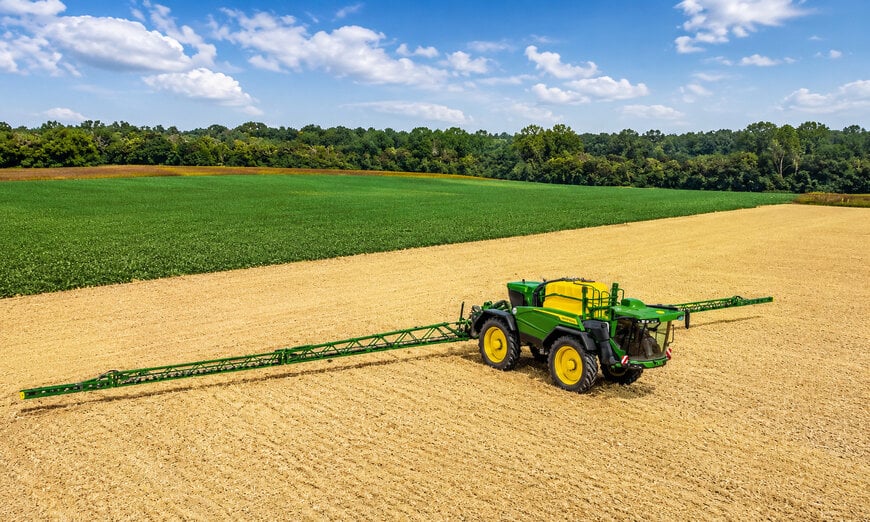
Large arable farms and agricultural contractors must optimize narrow application windows while satisfying precise product placement standards. Extended downtime from frequent tank refilling and the instability of wide spray booms at higher forward speeds limit treatment accuracy and increase drift risks. To address these productivity constraints without modifying the vehicle's standard over-the-road transport footprint, a high-capacity fluid delivery architecture featuring active boom geometry control has been engineered.
Modular boom kinematics and ultrasonic height regulation
The hardware architecture integrates a new generation of modular steel spray booms designed to provide working widths of 30, 36, or 42 meters. The mechanical structure utilizes a double- or triple-folding design that maintains a standard transport width of 2.55 meters. To prevent mechanical failure from field impacts, all stainless-steel spray lines and nozzle assemblies are fully enclosed within the structural framework.
Boom stabilization relies on an automatic tracking system that monitors ground and crop contours. Depending on the configuration width, the system deploys five or seven ultrasonic sensors to dynamically regulate operating height. The central frame incorporates active yaw and roll actuators. This kinematic mechanism counteracts chassis oscillations caused by topography and lateral acceleration, stabilizing the structure across its full width to permit a maximum operational spraying speed of 30 km/h.
Fluid management and automated documentation integration
The integration of chemical solution delivery and agronomic data is executed via a suite of automated modules designed to standardize transfer operations and regulatory tracking:
- A dual-circuit solution system equipped with a dedicated clean-water pump delivering a maximum filling rate of 1,200 liters per minute.
- Individual nozzle control modules enabling multi-rate application across 15 distinct sections with active turn compensation.
- An automated rinse interface featuring sequenced air purge and dilution functions to eliminate chemical residues.
Operational management relies on a balanced 50:50 weight distribution achieved by positioning the cabin at the front axle and the engine at the rear. Machine settings and field guidance lines are transferred directly to the sprayer via a remote setup platform prior to field entry. The system automatically generates field application logs exportable as spreadsheet files, simplifying compliance validation with environmental and governmental regulatory authorities.
Additional Context: This section details technical specifications and competitive benchmarking not included in the original product announcement.
Within the high-capacity self-propelled sprayer market, the 6,000-liter capacity platform competes directly with established systems such as the Fendt Rogator series and the Amazone Pantera series. Objective benchmarking reveals distinct trade-offs regarding boom material choices and fluid dynamics. While several competitors utilize aluminum boom structures to minimize rear-axle loading, the modular steel design of this platform maintains higher torsional fatigue resistance during 30 km/h operating speeds, compensated structurally by the 50:50 front-to-rear machine weight distribution.
Furthermore, the integration of proprietary individual nozzle control systems maintains uniform spray delivery and droplet size spectra independent of vehicle acceleration, whereas conventional step-variable pressure systems exhibit variations in drift potential. However, the current maximum boom width of 42 meters falls short of competing aluminum or carbon-fiber variants that achieve spans of 48 to 52 meters, though those larger configurations often require specialized folding mechanisms to match standard European road transport clearances.
Edited by Sucithra Mani, Induportals editor – adapted by AI.
www.deere.co.uk
Additional Context: This section details technical specifications and competitive benchmarking not included in the original product announcement.
Within the high-capacity self-propelled sprayer market, the 6,000-liter capacity platform competes directly with established systems such as the Fendt Rogator series and the Amazone Pantera series. Objective benchmarking reveals distinct trade-offs regarding boom material choices and fluid dynamics. While several competitors utilize aluminum boom structures to minimize rear-axle loading, the modular steel design of this platform maintains higher torsional fatigue resistance during 30 km/h operating speeds, compensated structurally by the 50:50 front-to-rear machine weight distribution.
Furthermore, the integration of proprietary individual nozzle control systems maintains uniform spray delivery and droplet size spectra independent of vehicle acceleration, whereas conventional step-variable pressure systems exhibit variations in drift potential. However, the current maximum boom width of 42 meters falls short of competing aluminum or carbon-fiber variants that achieve spans of 48 to 52 meters, though those larger configurations often require specialized folding mechanisms to match standard European road transport clearances.
Edited by Sucithra Mani, Induportals editor – adapted by AI.
www.deere.co.uk
