
www.agritechmag.com
28
'26
Written on Modified on
John Deere unveils JD AI assistant at Farm Progress Show 2026
AI assistant analyzes farmers’ field, machine and operational data, providing practical insights for improving yields, efficiency and farm decision-making.
www.deere.com
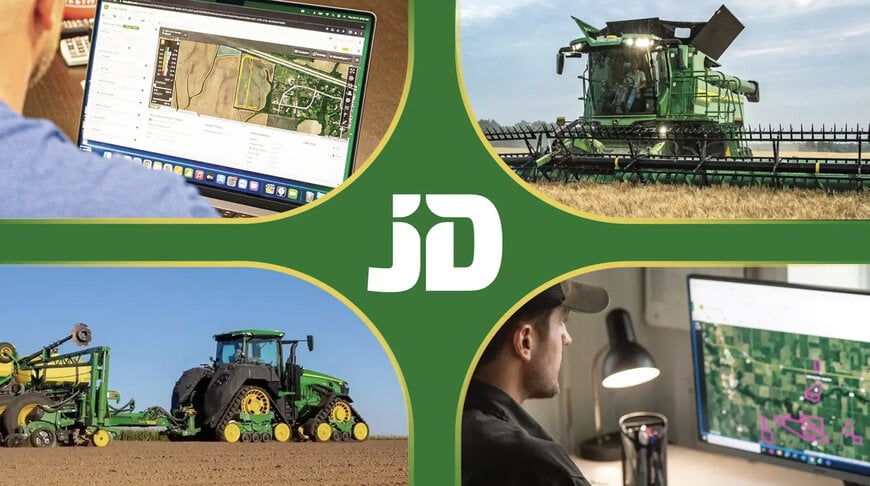
John Deere has launched JD, an artificial intelligence assistant integrated into the John Deere Operations Center platform to analyze telematics, agronomic records, and machine fleet performance. The conversational software architecture targets production agriculture, providing automated query retrieval and operational decision support across field preparation, seeding, crop protection, and harvest logistics.
Conversational Agronomic Querying and Machine Analytics
The technical implementation embeds a large language model framework directly into the centralized John Deere Operations Center database, replacing manual report compilation and dashboard navigation with natural language processing interfaces. By executing parameterized queries against structured spatial and sensor data streams, the assistant retrieves multi-year operating metrics within seconds.
Technical use cases focus on isolating operational variables to improve resource efficiency and mechanical performance. The system calculates comparative diesel consumption across multi-year tillage passes to identify optimal throttle and gear selections. In seeding operations, it cross-references seed meter singulation percentages against spatial yield maps to quantify the mechanical impact of planter calibration on final bushel output. For chemical application, the model benchmarks individual sprayer operators by sprayed acres per hour to evaluate field transit efficiency. Additionally, historical harvesting logs and weather records are analyzed to establish optimal operational windows for combine fleets, assisting with seasonal labor distribution.
Data Sovereignty and Operational Privacy Architecture
To support large-scale algorithmic evaluation of farm records, John Deere established a formal ten-point Farmer Data Commitment framework. The governance architecture mandates that raw operational data remains the proprietary asset of the farm operator. Data transmission to third-party software platforms or equipment dealers requires explicit opt-in consent and can be revoked at any time.
The institutional framework explicitly restricts John Deere from selling user data or using agricultural operational metrics for commodity trading and market speculation. Internal platform data usage is restricted to anonymized, aggregated datasets designated for algorithmic training, remote machine diagnostic telemetry, and predictive maintenance modeling. Deanna Kovar, President of Worldwide Ag and Turf Production and Precision Ag, noted that precision decision systems require verified structural boundaries governing data transparency, user-controlled data distribution, and measurable operational returns.
Multi-Platform Deployment and Cross-Industry Expansion
The conversational assistant was presented to agricultural operators at the 2026 Farm Progress Show, held from September 1 to September 3 in Boone, Iowa, where demonstrations took place at Outdoor Lots 144 and 153 on West Progress Avenue. Initial deployment began through a restricted Early Access Program for verified agricultural enterprises in the United States.
Subsequent deployment milestones include progressive feature integration across web browsers, mobile operating systems, and native Generation 4 and Generation 5 in-cab display hardware. Beyond production row-crop agriculture, the underlying machine analytics and language processing modules are scheduled for engineering adaptations across turf maintenance, heavy construction equipment, roadbuilding machinery, and forestry operations.
Additional Context:
This section details technical specifications and competitive benchmarking not included in the original product announcement
Agricultural data assistants operate under emerging standards for machine data interchange, primarily ISO 11783 (ISOBUS) protocols and AgGateway ADAPT data interoperability plugins, while data governance models are benchmarked against the independent Ag Data Transparent (ADT) certification standard.
In precision agriculture, competitive platforms have deployed distinct generative AI and machine learning architectures to synthesize agronomic data. Bayer Crop Science has piloted conversational large language model tools within Climate FieldView, including its proprietary E.L.Y. generative agronomy model trained on agronomic trial datasets and product positioning literature. While Bayer’s conversational tools emphasize agronomic prescriptions, hybrid seed selection, and chemical efficacy, John Deere’s implementation distinguishes itself by integrating low-level Controller Area Network (CAN-bus) telematics—such as engine load factor, hydraulic pressure, wheel slip, and fuel flow rates—with spatial geospatial layers.
Among mixed-fleet precision technology providers, PTx Trimble and CNH Industrial rely on API-driven telemetry hubs linked with farm management information systems (FMIS) such as Raven Slingshot and Case IH AFS Connect. These competing platforms primarily deliver operational monitoring through pre-configured rule engines and threshold alerts rather than integrated conversational retrieval models embedded natively across the equipment display architecture.
Edited by Natania Lyngdoh, Induportals editor, assisted by AI.
www.deere.com
