
www.agritechmag.com
23
'26
Written on Modified on
AI-driven automation transforms precision agriculture
Digital workbench explains how AI-based systems enable resource-efficient farming through real-time decision-making and autonomous field operations.
www.harting.com
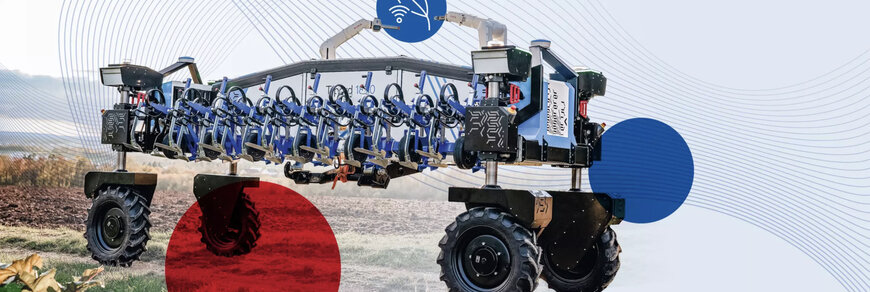
Advances in AI-supported automation are enabling precise, adaptive agricultural processes that improve resource efficiency and address labour shortages. These systems combine sensing, edge computing, and autonomous actuation to support selective interventions in complex biological environments.
From rule-based control to adaptive field intelligence
Traditional agricultural automation relied on predefined “if–then” logic, suitable for repetitive and predictable tasks. However, modern farming environments are inherently variable, shaped by weather, soil conditions, and biological diversity.
AI-supported systems introduce a shift toward adaptive decision-making, where machines can recognise, evaluate, and respond to field conditions in real time. This transition is particularly relevant in applications such as orchard harvesting, vineyard management, and targeted weed control, where plant-level variability requires context-aware responses.
Convergence of sensing, AI, and edge computing
Recent developments in precision agriculture are driven by the convergence of several technologies: high-performance edge computing, adaptive image processing, and satellite-based positioning systems.
Autonomous carrier platforms illustrate this integration. These machines operate as mobile base units equipped with:
- High-accuracy satellite navigation for consistent tracking
- Sensor systems for monitoring machine status and environmental conditions
- Camera-based AI modules for plant analysis and classification
Data processing occurs locally on the machine using edge computing architectures, eliminating dependence on cloud connectivity. This enables low-latency decision-making, which is critical for real-time field operations.
Selective intervention and resource efficiency
AI-enabled systems support selective, plant-specific actions rather than uniform treatment across entire fields. For example, mechanical tools guided by computer vision can remove weeds with high spatial precision, while attached implements adjust their behaviour based on individual plant characteristics.
This selective approach reduces the use of water, fertilisers, and agrochemicals, contributing to more sustainable agricultural practices. It also improves operational efficiency by focusing resources only where needed, aligning with the requirements of a digital supply chain in food production.
Reliability challenges in agricultural environments
While software and AI capabilities are advancing rapidly, hardware reliability remains a critical factor in field deployment. Electrical systems, rather than mechanical components, are often the primary source of failures.
Key vulnerabilities include:
Selective intervention and resource efficiency
AI-enabled systems support selective, plant-specific actions rather than uniform treatment across entire fields. For example, mechanical tools guided by computer vision can remove weeds with high spatial precision, while attached implements adjust their behaviour based on individual plant characteristics.
This selective approach reduces the use of water, fertilisers, and agrochemicals, contributing to more sustainable agricultural practices. It also improves operational efficiency by focusing resources only where needed, aligning with the requirements of a digital supply chain in food production.
Reliability challenges in agricultural environments
While software and AI capabilities are advancing rapidly, hardware reliability remains a critical factor in field deployment. Electrical systems, rather than mechanical components, are often the primary source of failures.
Key vulnerabilities include:
- Corrosion in connectors due to exposure to moisture and chemicals
- Inadequate crimping or poor contact quality
- Insufficient strain relief leading to cable fatigue
To ensure system availability, components must meet stringent requirements for watertightness, vibration resistance, mechanical locking, and durability under high-pressure cleaning conditions. Proper cable routing and protection are essential to maintaining long-term operational stability.
Agriculture as a frontier for advanced automation
The increasing complexity of agricultural automation highlights its role as a demanding application domain. Unlike controlled industrial environments, arable farming requires systems capable of interacting with living, heterogeneous organisms under changing conditions.
By integrating AI, sensor technology, and robust electromechanical design, modern agricultural systems demonstrate how automation can extend beyond factories into dynamic, real-world environments. This evolution positions agriculture as a key driver of innovation in autonomous systems, where ecological constraints and technological capabilities must be balanced in practical operation.
Edited by an industrial journalist Sucithra Mani with AI assistance.
www.harting.com
Agriculture as a frontier for advanced automation
The increasing complexity of agricultural automation highlights its role as a demanding application domain. Unlike controlled industrial environments, arable farming requires systems capable of interacting with living, heterogeneous organisms under changing conditions.
By integrating AI, sensor technology, and robust electromechanical design, modern agricultural systems demonstrate how automation can extend beyond factories into dynamic, real-world environments. This evolution positions agriculture as a key driver of innovation in autonomous systems, where ecological constraints and technological capabilities must be balanced in practical operation.
Edited by an industrial journalist Sucithra Mani with AI assistance.
www.harting.com
