
www.agritechmag.com
20
'26
Written on Modified on
Amazone advances fertiliser spreaders with radar-based automation
Harting highlights how sensor integration and real-time data enable adaptive fertiliser spreading in precision agriculture.
www.harting.com
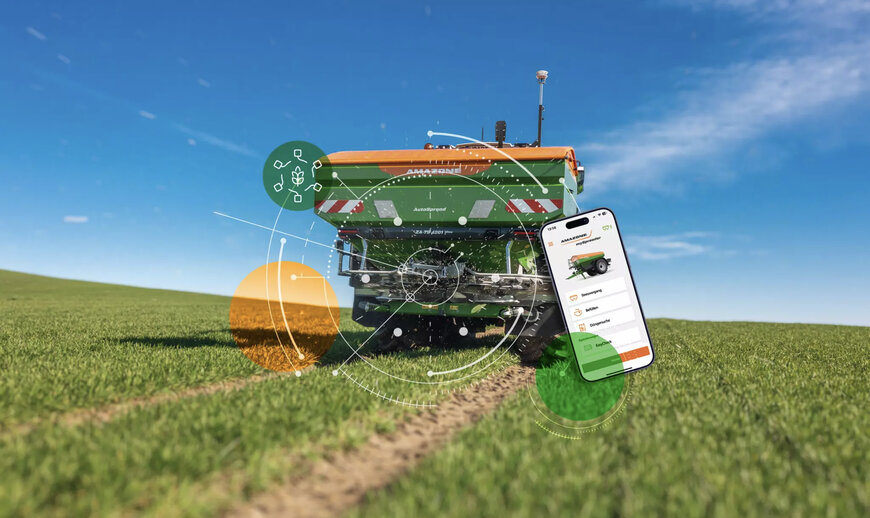
Precision agriculture, crop production, and smart farming systems are increasingly shaped by sensor technology and automation. In this context, Amazone has introduced a new generation of fertiliser spreaders that integrates radar sensing, real-time data processing, and cloud connectivity to improve application accuracy and enable continuous system optimisation.
Automation in agricultural machinery has evolved steadily since the 1990s, with early systems such as automatic boom height control using ultrasound and later section control technologies reducing overlap and operator workload. More recent developments extend beyond individual functions to entire process chains, where geodata-driven planning tools such as EasyTram enable preconfigured field operations. However, limited connectivity in field environments requires most control algorithms to run locally on machines, with only selected data transmitted externally.
The latest fertiliser spreaders from Amazone represent a shift toward fully monitored and adaptive spreading processes.
Radar-based monitoring for lateral and longitudinal distribution
The system integrates 16 radar sensors to continuously monitor fertiliser application. Seven sensors on each side measure the discharge angle of the spreading discs, ensuring accurate lateral distribution. Two additional sensors track the actual throwing distance, comparing the trajectory of fertiliser granules with stored reference data in real time.
This configuration enables simultaneous control of both lateral and longitudinal distribution, a capability not previously available in conventional spreaders. Deviations from target values are detected immediately, prompting corrective actions such as operator-initiated spreading tests. This closed-loop monitoring reduces variability caused by changing fertiliser properties, wind conditions, or machine settings.
Data-driven optimisation across the machine lifecycle
All operational data generated during spreading is transmitted to cloud-based systems, where it supports continuous improvement of algorithms and system performance. Unlike traditional spreading tables, which rely on static calibration data, the new approach enables dynamic adjustment based on real-world operating conditions.
This feedback loop extends beyond machine operation. Dealers gain access to detailed diagnostic data for maintenance and calibration, while fertiliser producers can receive insights into batch characteristics based on application behaviour. As a result, the system evolves over time, improving accuracy and consistency across multiple usage cycles.
Toward autonomous field operations
The integration of real-time sensing and adaptive control contributes to higher levels of process automation in agriculture. According to operational data, the system achieves approximately 99% process monitoring during fertiliser application. Remaining challenges relate primarily to environmental safety, particularly at spreading distances of up to 72 metres, where external conditions must still be considered.
While artificial intelligence is increasingly used in applications such as image-based weed detection via cameras or drones, fertiliser spreading continues to rely mainly on deterministic control systems. AI-driven optimisation occurs primarily in the background, refining algorithms based on accumulated operational data.
The new generation of fertiliser spreaders illustrates how combining sensors, edge computing, and cloud-based analytics can enhance precision in agricultural applications. By enabling machines to monitor and adjust their performance continuously, such systems support more efficient input use and contribute to the broader development of autonomous farming technologies.
Edited by Natania Lyngdoh, Induportals Editor — Adapted by AI.
www.harting.com
