
www.agritechmag.com
28
'26
Written on Modified on
Regenerative Agriculture Data Platform Adoption in European Corn Supply
Programme integrates Tate & Lyle and Regrow Ag platforms to measure and model agronomic performance and environmental outcomes with French cooperatives.
www.regrow.ag
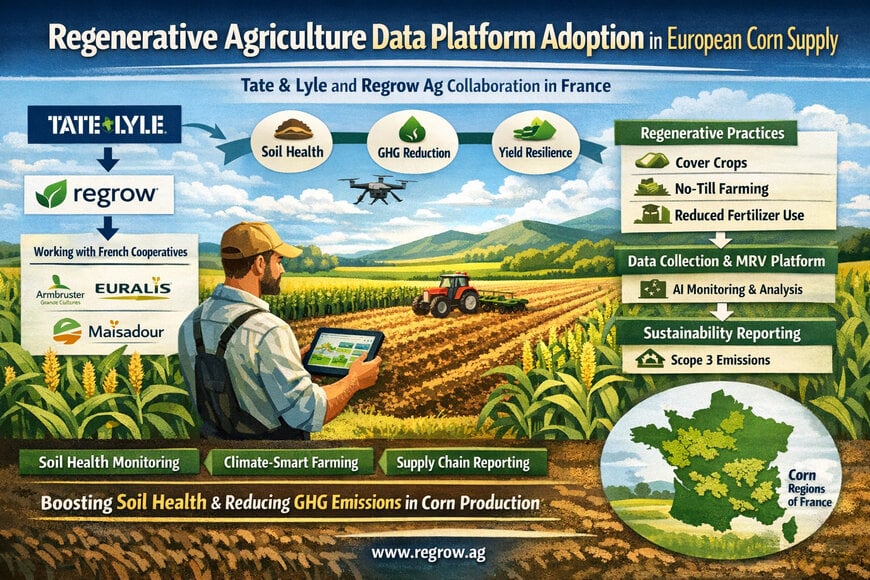
Tate & Lyle and Regrow Ag Collaborate on European Regenerative Agriculture Data Integration to Support Corn Growers Across France and Supply Chain Reporting.
The cooperation applies Regrow’s AI-driven agriculture resilience platform to quantify regenerative agriculture practices in French corn production, enabling data-driven monitoring of soil health and greenhouse gas (GHG) impacts while supporting supply chain resilience for ingredient processing and industrial food applications.
Context of the Cooperation
Tate & Lyle PLC, a global food and beverage ingredients supplier with established regenerative agriculture programmes in the United States and China, has extended its initiative into Europe in partnership with Regrow Ag, a provider of measurement, reporting, and verification (MRV) software for regenerative agriculture.
The initiative addresses operational challenges associated with climate variability in agricultural supply chains, specifically crop resilience and soil degradation in corn cultivation regions of northeast and southwest France. Tate & Lyle sources significant volumes of waxy corn for speciality ingredients; therefore, enhancing on-farm sustainability practices and quantifying their environmental impact are critical to long-term supply stability and industrial reporting.
Technical Solution and Responsibilities
The cooperation deploys Regrow Ag’s AI-driven agriculture resilience platform to collect and model farm-level data on regenerative practices. Participating growers, coordinated with three major cooperatives (Armbruster Grande Cultures, Euralis Groupe Coopératif and Groupe Coopératif Maïsadour), submit agronomic and soil data into the platform.
Core practices evaluated include low and no-till cultivation to reduce soil disturbance, cover cropping to enhance soil structure and biodiversity, and nitrogen management techniques to lower synthetic fertiliser use. These practices align with agronomic principles linked to improved soil organic matter and reduced GHG emissions and are tracked via standardized indicators integrated into Regrow’s analytics.
Regrow is responsible for platform operation, data modelling, and analytics, while local agronomists assist farmers with data entry and interpretation. Tate & Lyle integrates verified results into its environmental reporting systems to support internal and external sustainability disclosures.
Deployment and Integration
The programme has been implemented on thousands of acres across key corn-growing regions in France. Data flows from field practices into the MRV platform, enabling temporal trend analysis of soil health metrics and estimated GHG impacts. This integration allows Tate & Lyle and its customers to incorporate quantified environmental outcomes into broader sustainability frameworks, such as Scope 3 emissions reporting.
Operational deployment includes phased engagement with farmers: initial practice adoption, data collection with agronomic support, and iterative feedback loops from platform analytics to inform farm management decisions.
Applications and Use Cases
In industrial agriculture and food supply contexts, the programme supports:
- Soil Health Monitoring – objective measurement of soil carbon proxies and disturbance indicators.
- Climate-Smart Farming – quantifiable assessment of regenerative practices’ contribution to GHG mitigation.
- Supply Chain Reporting – integration of verified farm-level data into corporate environmental performance metrics.
Such data is valuable for sustainability reporting, compliance with emerging environmental standards, and strategic planning in industrial food supply chains.
Expected Impact
While specific quantitative results have not been published, the cooperation enhances data transparency and supports evidence-based assessment of regenerative practices. Improved soil health and reduced reliance on synthetic inputs are associated with increased resilience to climate stressors and potential yield stability over multi-year adoption periods, factors relevant to industrial corn procurement.
Technical Insight from Partners
Anastasia Volkova, CEO and Co-Founder of Regrow Ag, emphasized that coupling local agronomic expertise with AI-powered measurement strengthens the credibility of regenerative practice outcomes across supply chains.
www.regrow.com
Expected Impact
While specific quantitative results have not been published, the cooperation enhances data transparency and supports evidence-based assessment of regenerative practices. Improved soil health and reduced reliance on synthetic inputs are associated with increased resilience to climate stressors and potential yield stability over multi-year adoption periods, factors relevant to industrial corn procurement.
Technical Insight from Partners
Anastasia Volkova, CEO and Co-Founder of Regrow Ag, emphasized that coupling local agronomic expertise with AI-powered measurement strengthens the credibility of regenerative practice outcomes across supply chains.
www.regrow.com
