
www.agritechmag.com
05
'26
Written on Modified on
ZEISS AURA analyzer brings NIR analysis directly to feed
ZEISS introduces the portable AURA analyzer, bringing near-infrared spectroscopy directly to barns, silos, and fields for rapid, representative forage and feed assessment.
www.zeiss.com
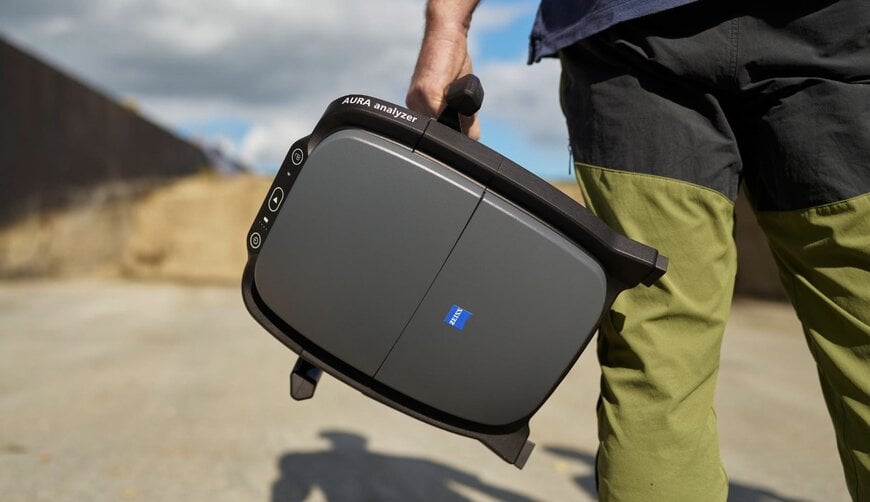
Dairy producers, livestock operations, and feed consultants face ongoing challenges in formulating balanced nutritional rations due to natural chemical and moisture variations across raw forage and silage. Traditional feed analysis workflows rely heavily on taking field grab samples and dispatching them to centralized wet-chemistry or benchtop spectroscopy laboratories. This external routing creates analytical turnaround delays ranging from several days to weeks, forcing nutritionists to formulate rations based on outdated constituent data. During the interim, unmonitored fluctuations in dry matter, crude protein, fiber fractions, or moisture content can degrade ruminal fermentation, depress milk yields, and increase feed waste across dairy herds. Mitigating these nutritional variations requires rugged, portable near-infrared testing hardware that captures representative, macro-scale sample volumes and delivers lab-grade constituent breakdowns directly at the feeding bunk, silo face, or field edge within seconds.
Representative Sample Presentation and Mobile Spectroscopy
To shorten analysis turnaround and eliminate logistical delays, ZEISS Spectroscopy developed the AURA analyzer, making its commercial premiere at the EuroTier exhibition in Hanover. Designed for mobile, on-site deployment, the portable instrument allows dairy farmers and nutrition consultants to quantify feed composition and adjust feed rations dynamically at the sampling point.
A primary engineering hurdle in portable agricultural spectroscopy involves sample heterogeneity, as coarsely chopped forages, grass silages, and mixed rations exhibit substantial physical variability that skews micro-spot optical readings. To counter this, the AURA analyzer incorporates an enlarged optical measurement window paired with a generously dimensioned sample dish to accommodate a significantly larger, more representative testing volume. Sample presentation is further standardized via an integrated mechanical pressure plate that applies uniform compaction across the specimen, eliminating air voids and mitigating measurement errors stemming from uneven surface density. The analyzer is operated via a guided mobile application, which walks operators through sample preparation and displays nutrient breakdowns immediately following measurement.
Cloud Connectivity and Agricultural Circularity
The ruggedized, field-ready instrument transitions optical results directly into actionable ration management via the ZEISS Cloud Platform. This digital link enables data synchronization across farm management systems, allowing nutrition consultants to review localized constituent curves remotely and update Total Mixed Ration (TMR) mixes in real time.
Christian Schultheiss, Head of Digital Innovation at ZEISS Spectroscopy, noted that the analyzer reduces the pathway between initial raw-material sampling and actionable data, establishing an immediate digital trail for feed strategy formulation. Dr. Jochen Hallmann, Head of the Agri/Food Business Field at ZEISS Spectroscopy, highlighted that precision optical sensing is becoming essential for economic decision-making across agricultural circular economies, providing transparency and data integrity across the livestock production chain.
Additional Context
This section details technical specifications and competitive benchmarking not included in the original product announcement.
In agricultural near-infrared spectroscopy governed by ISO 12099 standards for animal feeding stuffs, diffuse reflectance measurements operate primarily across the short-wavelength near-infrared (SW-NIR) and long-wavelength NIR regions (typically between 950 nm and 1650 nm). In this optical band, first, second, and third overtones of molecular stretching bonds—including carbon-hydrogen, oxygen-hydrogen, and nitrogen-hydrogen bonds—correspond directly to moisture content, crude protein, neutral detergent fiber (NDF), acid detergent fiber (ADF), and starch. Standardizing sample presentation via a controlled top-down pressure plate is critical for diffuse reflectance measurements, as variation in sample bulk density alters the optical path length and diffuse scatter coefficients, skewing multivariate Partial Least Squares (PLS) chemometric regression calibrations. Integrating cloud-synchronized calibration curves allows the device to automatically update local spectral models against seasonal crop variations without manual benchtop recalibration.
Within the portable agricultural NIR market, the ZEISS AURA analyzer benchmarks directly against established on-farm spectrometers and handheld analyzers such as the FOSS microFOSS and AgriNIR series (from Dinamica Generale), the trinamiX Mobile NIR Spectroscopy solution, and the Si-Ware NeoSpectra platform. While ultra-miniature, micro-electromechanical systems (MEMS) spectrometers offer pocket-sized convenience, their sub-centimeter optical aperture windows frequently suffer from severe sampling errors when scanning coarsely chopped, non-homogeneous forage materials like whole-crop corn silage or long-stem hay. Conversely, traditional transportable benchtop systems require external AC power connections and climate-controlled enclosures, restricting their utility inside dusty barns or exposed silos. By combining a wide-aperture measurement window and mechanical compaction plate with cloud-connected mobile app interfaces, ZEISS bridges the gap between laboratory-grade optical representativeness and ruggedized, battery-powered field mobility.
Edited by Romila DSilva, Induportals Editor, with AI assistance.
www.zeiss.com
