
www.agritechmag.com
08
'26
Written on Modified on
Agricultural Machine Connectivity and Field Autonomy
AGCO PTx deploys retrofit autonomy and artificial intelligence to coordinate mixed equipment fleets across tight seasonal crop cycles.
www.agcocorp.com
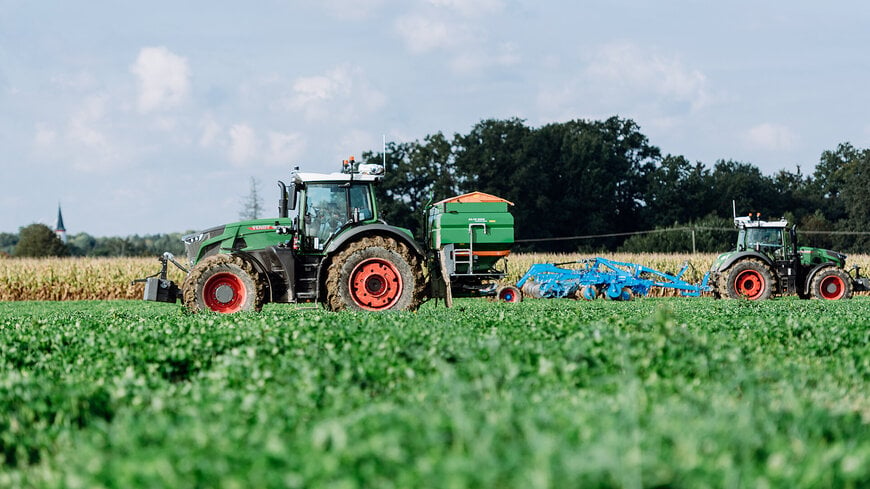
Agricultural producers face severe labor shortages and compressed operational windows during planting and harvest, where misaligned field operations cause yield loss and chemical waste. Mixed-fleet machinery connectivity and targeted field robotics address these scheduling bottlenecks by enabling multi-brand equipment to coordinate operations autonomously without requiring complete machinery replacement.
Addressing Interoperability Bottlenecks in Field Logistics
Commercial farming operations typically maintain equipment from multiple manufacturers across tractors, combines, sprayers, and implements. Incompatible proprietary data architectures historically prevented these machines from sharing telemetry and agronomic data in real time, forcing operators into manual coordination. AGCO demonstrated a cross-brand precision approach at its annual Tech Day at Stewart Farms near Yorkville, Illinois, showcasing how integrated digital layers coordinate legacy and modern machines.
Central to this workflow is the PTx FarmENGAGE platform, which standardizes operational data streams across mixed fleets into a common digital framework. Agronomic layers feed into the Panorama intelligence system, aggregating machine performance, yield metrics, and field maps. Within this architecture, the Aurora artificial intelligence assistant functions via natural language query processing, interpreting voice or text commands to retrieve spatial maps and machine telemetry without requiring operators to manually sift through multi-layered GIS files.
Targeted Sensing and Automated Planting Precision
Seed singulation and consistent trench placement directly determine emergence rates. By pairing Momentum planters with ArrowTube delivery mechanisms, the mechanical pathway stabilizes seed descent to eliminate bounce and maintain spatial uniformity. Operating in tandem with Panorama mapping layers, the system documents placement density against soil variability to establish baselines for downstream operations.
Chemical weed management has shifted from broadcast coverage to targeted application methods. The Fendt Rogator 900 utilizes the AI-driven SymphonyVision optical sensing system to identify unwanted vegetation against bare ground and crop canopies. High-speed vision sensors process field imagery in real time to actuate individual spray nozzles exclusively over detected weeds. This localized targeting curtails chemical volumes, reduces input costs, and limits chemical resistance pressures while maintaining drift control.
Autonomous In-Field Logistics and Harvest Coordination
Harvest logistics present critical scheduling constraints, as combining, grain handling, primary tillage, and post-harvest fertilizer placement must occur within a six-to-eight-week period. Labor shortages frequently leave harvesting machines idling while waiting for transfer carts, or delay tillage until soil conditions deteriorate.
During field demonstrations, the Fendt IDEAL combine operated alongside PTx OutRun, a retrofit autonomy package that converts existing tractors into autonomous grain cart haulers. OutRun governs vehicle guidance, speed synchronization, and offloading paths between the combine and staging points. Behind the harvesting pass, an autonomous tillage unit prepares the seedbed while a Fendt Rogator applies baseline fertilizer, ensuring immediate nutrient incorporation into the soil profile before environmental precipitation causes runoff losses.
Equipment Fleet Diagnostics and Servicing Frameworks
Autonomous operations require minimal unpredicted downtime. Through the FarmerCore service model, machine telematics are linked to remote diagnostics and over-the-air firmware updates. Field service technicians utilize real-time diagnostic trouble codes to preempt component failures, dispatching on-farm mobile support units equipped with targeted replacement components to eliminate unnecessary transport cycles.
Additional Context
This section details technical specifications and competitive benchmarking not included in the original product announcement.
Mixed-fleet retrofitting reflects a major industry trend toward vendor-neutral communication protocols governed by ISO 11783 standards, commonly known as ISOBUS. While original equipment manufacturers historically deployed closed CAN bus protocols to retain machine ecosystems, interoperability demands have driven the adoption of universal retrofit kits. Benchmark autonomous field systems, such as John Deere autonomous 8R packages or Raven Industries harvest logistics kits, often focus on specific chassis architectures or proprietary GNSS correction networks. Retrofit platforms like PTx OutRun compete by separating the guidance, perception, and throttle control actuation layers from proprietary brand chassis, permitting installation on existing mechanical platforms. Furthermore, camera-based "see-and-spray" technologies, such as John Deere See & Spray or Bilberry optical detection arrays, measure effectiveness by nozzle latency, edge-computing classification speed, and chemical reduction rates, with targeted spray systems typically achieving herbicide volume reductions between 60% and 85% compared to broadcast applications depending on weed density.
Edited by Evgeny Churilov, Induportals Media - Adapted by AI.
www.agcocorp.com
