
www.agritechmag.com
07
'26
Written on Modified on
Min-Till Seed Drill Precision Metering Technology
KUHN introduces ESPRO 1002 R and RC seed drills engineered for uniform seed placement, reduced draft force, and multi-product distribution.
www.kuhn.com
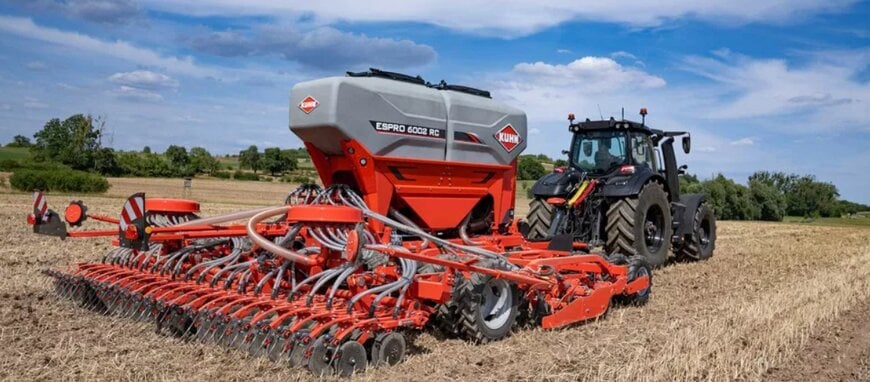
Consistent furrow opening and accurate seed metering remain core engineering hurdles in minimum-tillage arable farming, particularly when working across heavy plant residues at elevated travel speeds. To address these operational constraints across broad-acre crop production, agricultural implement manufacturer KUHN has developed the ESPRO 1002 R and RC trailed min-till seed drill range.
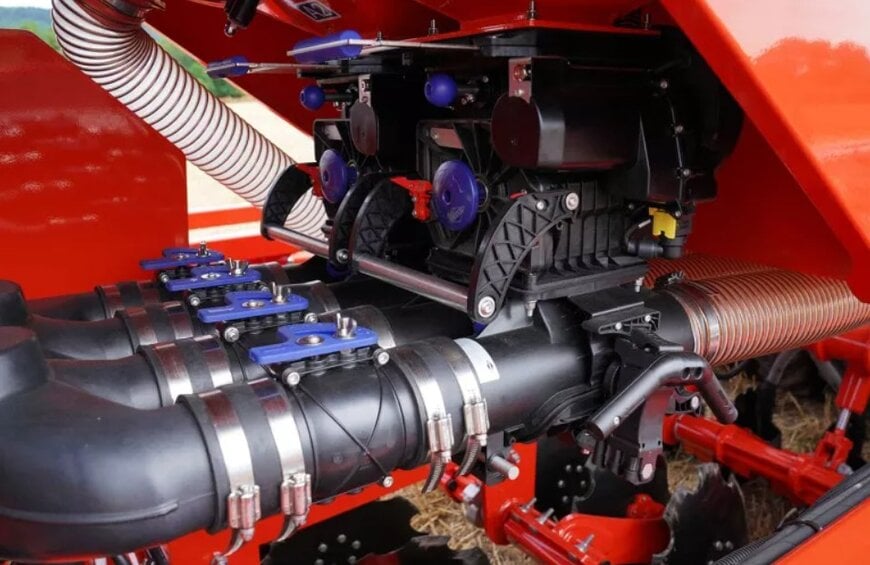
The equipment platform addresses operational efficiency by integrating a pressurized pneumatic distribution circuit with modular OPTISEED cassette metering units. Across minimum-tillage workflows, handling varied seed sizes alongside granular fertilizers often introduces bulk density variations and distribution segregation. The sealed pneumatic circuit maintains constant internal air pressure from the hopper to the distribution heads, preventing airflow drops that cause irregular seeding density. Positioning the distribution heads directly adjacent to the coulter line minimizes secondary transit delay, maintaining uniform cross-sectional delivery across working widths spanning 3 to 6 metres.
Coulter Stability and Furrow Penetration Mechanics
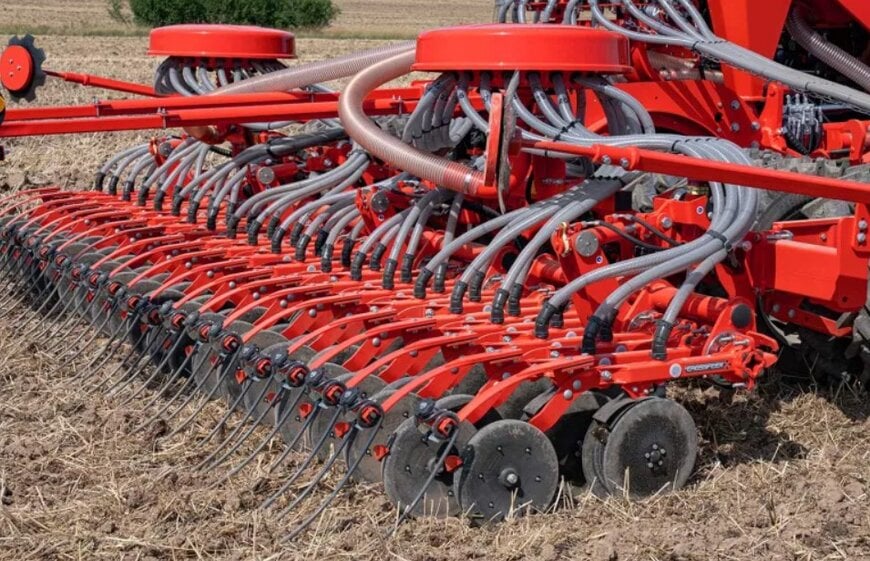
High-speed seedbed finishing requires stable coulter ground tracking to avoid depth variations caused by field topography and surface trash. The seeding line relies on the CROSSFLEX coulter bar assembly, utilizing 350 mm diameter double steel discs bevelled and offset by 41 mm. This offset geometry produces a clean cutting action through surface organic matter rather than hair-pinning residues into the furrow wall.
Ground contouring is managed through elastomeric polyurethane blocks mounted to a specialized cross-profile beam. This suspension mechanism isolates ground shocks and delivers coulter pressures reaching 120 kg per unit, preventing coulter bounce at higher operating speeds and holding the seed boot securely at the targeted depth index.
Sectional Control and Material Transfer Management
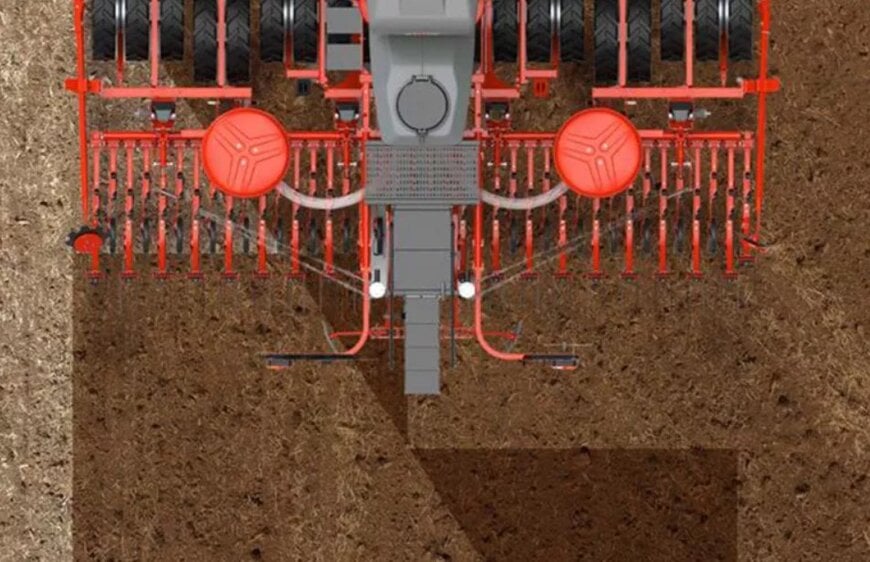
To minimize over-application and eliminate unseeded gaps in irregular field headlands or tapered point rows, the machines integrate an automated half-width shut-off system as standard equipment. The architecture deploys two metering assemblies per hopper linked to two or four distribution manifolds, depending on machine working width.
Rather than relying strictly on instantaneous mechanical shut-off, the control system calculates product transfer latency between the metering rollers and the soil openers. Operators input this calibrated transfer duration into the onboard terminal, allowing section timing to compensate for pneumatic pipe transit time before the implement enters or exits previously seeded headland zones.
Single-Shot and Double-Shot Multi-Product Placement
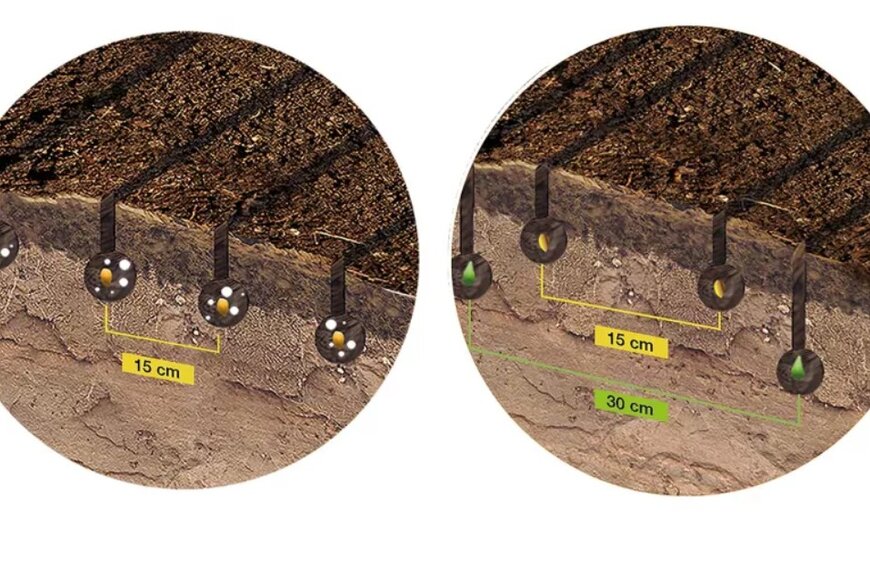
Arable rotations incorporating companion crops, under-sown covers, or concurrent starter fertilization require differentiated application paths. The single-hopper R configurations handle uniform single-species runs, whereas the dual-hopper RC variants support simultaneous application of two separate inputs.
In Single Shot mode, the system meters two distinct products through separate cassettes, blends them inside the centralized air stream, and directs both through a single coulter outlet into the primary seed trench. For agronomic regimes demanding separation between fertilizer and sensitive root systems, Double Shot mode isolates the two delivery lines and deposits the products at two independent, pre-calibrated soil depths.
Chassis Architecture and Headland Automation
Minimizing fuel expenditure during shallow cultivations depends heavily on tire-soil interaction. The running gear incorporates 900 mm diameter press wheels arranged in two staggered rows rather than a continuous transverse line. This offset wheel layout prevents soil accumulation and frontal soil pushing — known as the bulldozing effect — substantially lowering drawbar pull requirements. The narrow wheel profiles allow loose tilth and residues to flow through the intermediate clearances, while the square-profile tire casing compacts the seed zone evenly ahead of the openers.
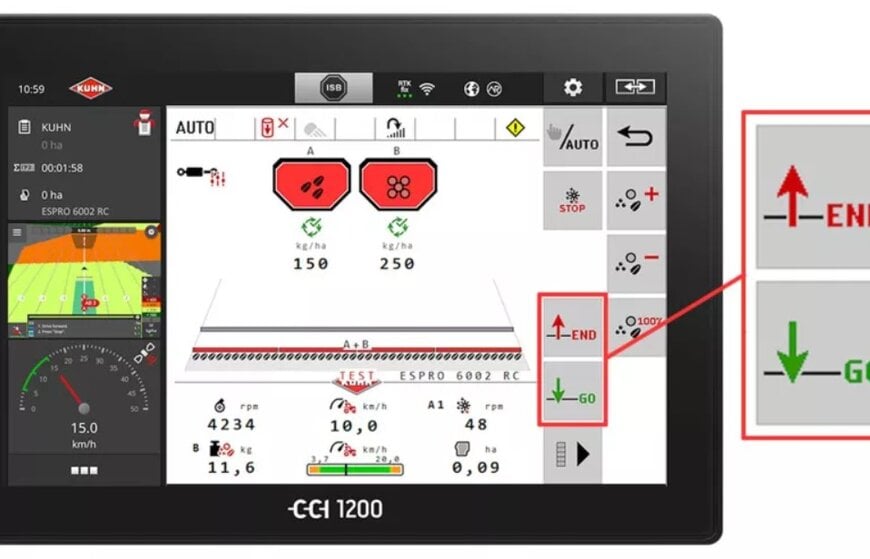
In-cab implement control functions via standard ISOBUS protocols. The automated GO & END headland sequence controls hydraulic lifting and lowering intervals across the working components in a fixed sequence, removing manual multi-spool valve cycling at field edges. Operational servicing is streamlined through quick-change OPTISEED metering cassettes, hopper platforms, and half-open hopper modes designed for rapid cleanout between differing seed batches.
Additional Context
This section details technical specifications and competitive benchmarking not included in the original product announcement.
Modern trailed pneumatic seed drills in the 3 to 6 metre min-till category operate within an equipment landscape shaped by ISO 11783 (ISOBUS) standards, Section Control compatibility, and variable-rate application (VRA) architectures. Standard pneumatic systems traditionally utilize ambient-pressure venturi injectors, which can experience distribution drop-off when back-pressure rises in high-application-rate regimes. Pressurized tank systems, adopted in advanced European seed drills, maintain positive container pressure to equalize pneumatic gradients, enabling high application volumes of dense fertilizer blends without venturi blockages.
Benchmark engineering approaches in this segment include continuous rubber packer rollers versus staggered pneumatic tire packers. Staggered packer arrangements reduce rolling resistance in damp, cohesive soils by staggering contact patches, whereas continuous steel or rubber rollers provide uninterrupted reconsolidation across the full furrow bed. High coulter pressures up to 120 kg match the upper operating threshold for min-till disc assemblies, ensuring soil penetration in uncultivated seedbeds comparable to dedicated conservation agriculture systems.
Edited by Evgeny Churilov, Induportals Media - Adapted by AI.
www.kuhn.com
