
www.agritechmag.com
07
'26
Written on Modified on
Engineered Wood Built-Up Beam Configurations
Tolko Industries details how T-TEC LVL built-up beam configurations substitute for factory-built billet beams to achieve wider structural dimensions on job sites.
tolko.com
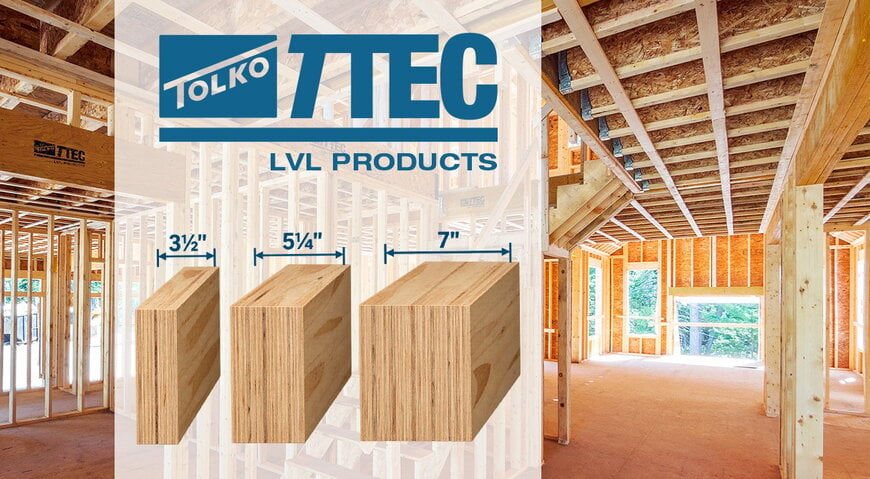
Sourcing large-dimension structural framing members on short lead times remains a persistent supply chain challenge in residential and commercial light-frame construction. Multi-ply laminated veneer lumber assemblies resolve these site delays by allowing framing crews to laminate standardized single plies into wider structural profiles that match standard architectural dimensions.
Structural framing designs frequently call for wide structural members to carry high uniform roof loads, multi-floor point loads, and large clear spans. Factory-glued solid members, commonly referred to as billet beams, provide these wide cross-sections as single structural units. However, project schedules often face disruptions when specific billet beam widths face extended mill lead times or localized supply constraints.
To prevent job-site work stoppages, structural engineers and framing contractors utilize built-up beam configurations as a direct technical alternative. Tolko Industries provides engineered configurations that permit individual plies of T-TEC LVL (laminated veneer lumber) to be fastened together on-site. By combining standard 1-3/4-inch plies using verified structural fastening schedules, framing crews assemble multi-ply members that achieve standard billet beam widths, specifically 3-1/2-inch (two plies), 5-1/4-inch (three plies), and 7-inch (four plies) dimensions.
The load-sharing mechanism in these field-assembled beams depends on rigorous mechanical fastening that transfers horizontal shear and distributes transverse loads equally among individual plies. When side-loaded by framing members such as joist hangers, improperly fastened multi-ply beams risk uneven load distribution, which overloads the ply adjacent to the applied force. Approved built-up configurations establish precise nailing, bolting, or structural screw spacing to ensure composite structural action, enabling the combined section to match the mechanical flexural and shear demands of an equivalent single-piece factory billet.
In practical framing workflows, field-assembled multi-ply systems provide distinct material-handling advantages over solid billet beams. Heavy single-piece billets typically require crane or telehandler support to lift and set into pocket foundations or post caps. Conversely, individual T-TEC LVL plies can be staged and lifted manually by framing crews, aligned in position, and fastened directly within the framing layout, streamlining installation across constrained urban job sites.
Additional Context
This section details technical specifications and competitive benchmarking not included in the original product announcement.
Laminated veneer lumber is manufactured by peeling continuous wood veneers, grading them ultrasonically for tensile stiffness, and laminating them with moisture-resistant exterior adhesives under heat and pressure, with the grain running parallel along the longitudinal axis. In North America, the manufacturing and design valuation of structural LVL assemblies are governed by ASTM D5456 (Standard Specification for Evaluation of Structural Composite Lumber Products) and recognized under the International Building Code (IBC) via evaluation service reports.
Field-assembled LVL beams compete directly with factory-glued LVL billets and multi-ply parallel strand lumber (PSL) or glued-laminated timber (glulam). Factory billet beams eliminate on-site mechanical fastening errors and provide uniform shear transfer through continuous structural adhesive lines rather than discrete mechanical fasteners. However, multi-ply built-up beams provide higher procurement flexibility, as yards can stock single-thickness inventory to satisfy multiple structural depth and width requirements on demand.
Edited by Evgeny Churilov, Induportals Media - Adapted by AI.
www.tolko.com
