
www.agritechmag.com
30
'26
Written on Modified on
Agricultural Drone Technology for Commercial Precision Crop Management
DJI launched the Agras T100, T70P, and T25P agricultural drones in Mexico to address high-volume crop spraying, spreading, and field transport challenges across diverse farming topographies.
ag.dji.com
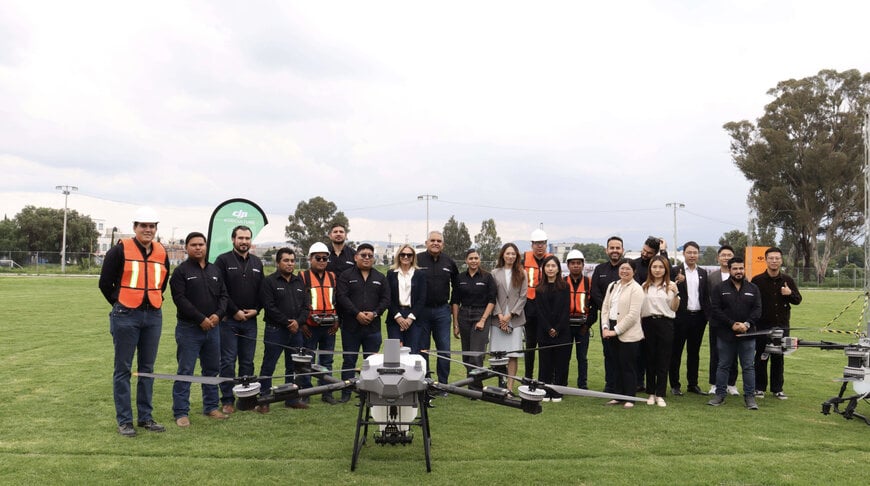
Large-scale farming operations and high-value fruit production face acute challenges regarding chemical delivery efficiency, input waste, and severe labor shortages across complex terrain. Conventional tractor-mounted sprayers often cause soil compaction and cannot access steep hillsides, while manual backpack spraying presents safety risks and low throughput. In response to these operational constraints, DJI introduced its next-generation agricultural drone platform to the Mexican commercial agriculture sector, releasing the Agras T100, Agras T70P, and Agras T25P through authorized regional distributors.
Operational Challenges Across Mountainous and Arid Crop Environments
Industrial producers handling broadacre crops such as corn, soybean, and sugarcane contend with high water loss in arid environments, while fruit growers in mountainous regions like Michoacán struggle with navigating uneven terrain and steep orchard canopy profiles. In avocado orchards, manual chemical delivery has historically required high water volumes with low land coverage rates.
Field data demonstrates that unmanned aerial spraying significantly lowers input dependency while boosting daily coverage. On a 3,000-hectare avocado operation, drone deployment reduced water consumption from 400 liters per hectare to 60 liters per hectare, representing a 40 percent operational cost reduction. Daily treatment throughput increased from 0.5 hectares per day under manual labor to 20 hectares per day, matching the labor output of 50 manual field workers.
Sensing Architecture and Multifunctional Aerial Payloads
The Agras T100 integrates active sensing hardware to navigate complex topography without pilot intervention. Its safety architecture combines light detection and ranging (LiDAR), millimeter-wave radar, and a five-sensor optical array designated as the Penta-Vision system. This sensor fusion protocol identifies slender branches and utility wires, establishing dynamic terrain-following paths along steep hillsides.
Beyond pesticide spraying and dry granule distribution, the updated platform incorporates heavy-lift transport capabilities. The flagship Agras T100 supports:
- Liquid spray capacity of 100 liters with operational flight speeds up to 20 meters per second.
- Granular spreading capacity of 150 liters, achieving a twofold throughput increase over preceding architectures.
- Suspended cargo winch transport with a maximum payload rating of 100 kilograms, facilitating input delivery across roadless orchard terrain.
The Agras T70P delivers balanced intermediate payloads, carrying up to 70 liters for liquid application, 100 liters for dry spreading, and 65 kilograms for cargo transport. For decentralized operations, the foldable Agras T25P operates as a single-operator platform designed for field mapping, terrain contouring, and localized plant protection.
Regional Integration and Workforce Qualification
Market deployment across Mexico follows a 56-fold increase in agricultural drone adoption between 2019 and 2025. Unmanned aerial systems now operate across 7.1 percent of domestic farmland, supported by an infrastructure network comprising 172 authorized storefronts and 73 technical service centers.
To support compliance and operational safety, DJI Academy expanded specialized flight training curricula through local training branches established since 2022. The program has certified nearly 3,000 pilots in precision application rates, flight path automation, drift control, and payload handling.
Additional Context:
This section details technical specifications and competitive benchmarking not included in the original product announcement.
Modern precision agricultural drones increasingly rely on high-capacity centrifugal atomization rather than standard pressure nozzles to eliminate system clogging during variable-rate application. The DJI Agras T100 utilizes twin or four-sprinkler centrifugal atomizers producing droplet diameters between 50 and 500 micrometers, providing delivery flow rates up to 40 liters per minute. Centimeter-level positioning relies on multi-band GNSS RTK receivers compatible with GPS, BeiDou, Galileo, and GLONASS, maintaining flight path accuracy within plus or minus 10 centimeters.
In the ultra-heavy agricultural unmanned aircraft category, competitive benchmark platforms include systems such as the XAG P100 Pro. While the Agras T100 delivers a 100-liter liquid payload and 150-liter solid hopper capacity, the XAG P100 Pro operates with an 80-liter granular container and a 50-liter liquid tank, supporting a maximum spray flow rate of 22 liters per minute. The integration of 100-kilogram cargo winch rigging further differentiates the T100 platform by extending industrial functionality from chemical dispersal into localized logistics and field supply transport.
Edited by Natania Lyngdoh, Induportals editor, with AI assistance.
www.ag.dji.com
Regional Integration and Workforce Qualification
Market deployment across Mexico follows a 56-fold increase in agricultural drone adoption between 2019 and 2025. Unmanned aerial systems now operate across 7.1 percent of domestic farmland, supported by an infrastructure network comprising 172 authorized storefronts and 73 technical service centers.
To support compliance and operational safety, DJI Academy expanded specialized flight training curricula through local training branches established since 2022. The program has certified nearly 3,000 pilots in precision application rates, flight path automation, drift control, and payload handling.
Additional Context:
This section details technical specifications and competitive benchmarking not included in the original product announcement.
Modern precision agricultural drones increasingly rely on high-capacity centrifugal atomization rather than standard pressure nozzles to eliminate system clogging during variable-rate application. The DJI Agras T100 utilizes twin or four-sprinkler centrifugal atomizers producing droplet diameters between 50 and 500 micrometers, providing delivery flow rates up to 40 liters per minute. Centimeter-level positioning relies on multi-band GNSS RTK receivers compatible with GPS, BeiDou, Galileo, and GLONASS, maintaining flight path accuracy within plus or minus 10 centimeters.
In the ultra-heavy agricultural unmanned aircraft category, competitive benchmark platforms include systems such as the XAG P100 Pro. While the Agras T100 delivers a 100-liter liquid payload and 150-liter solid hopper capacity, the XAG P100 Pro operates with an 80-liter granular container and a 50-liter liquid tank, supporting a maximum spray flow rate of 22 liters per minute. The integration of 100-kilogram cargo winch rigging further differentiates the T100 platform by extending industrial functionality from chemical dispersal into localized logistics and field supply transport.
Edited by Natania Lyngdoh, Induportals editor, with AI assistance.
www.ag.dji.com
