
www.agritechmag.com
24
'26
Written on Modified on
Predictive AI Yield Modeling in Smart Farming Systems
WiseYield, Cropin, and Bayer deploy predictive crop yield modeling to optimize harvest planning, stabilize supply chains, and calibrate agricultural resource allocation.
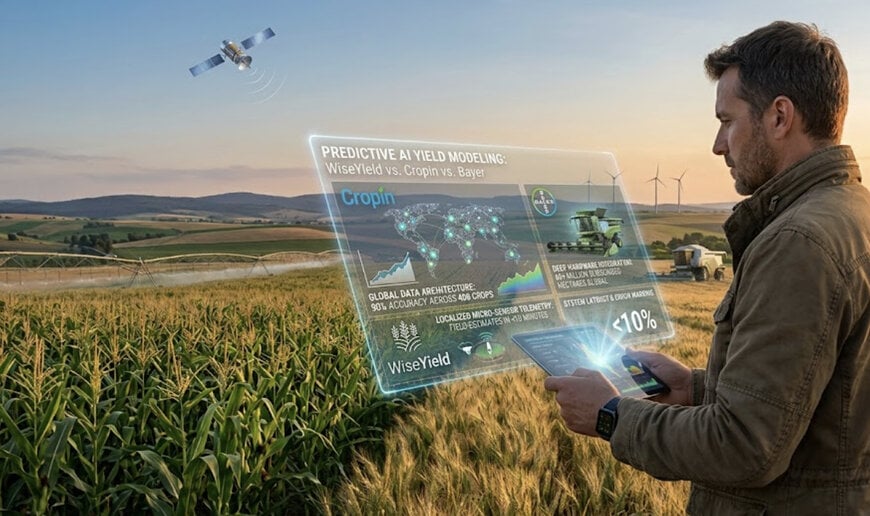
Predictive crop yield modeling utilizes artificial intelligence to estimate agricultural production volumes weeks prior to physical harvest. Integrating this capability into smart agriculture systems resolves significant supply chain bottlenecks, allowing agribusinesses to optimize grain storage logistics, negotiate forward contracts, and calibrate variable-rate chemical applications. By processing multi-spectral optical data and field telemetry, these systems replace manual sampling with dynamic projections, reducing input waste and stabilizing financial planning for global agricultural enterprises.
Current Technology Market Landscape
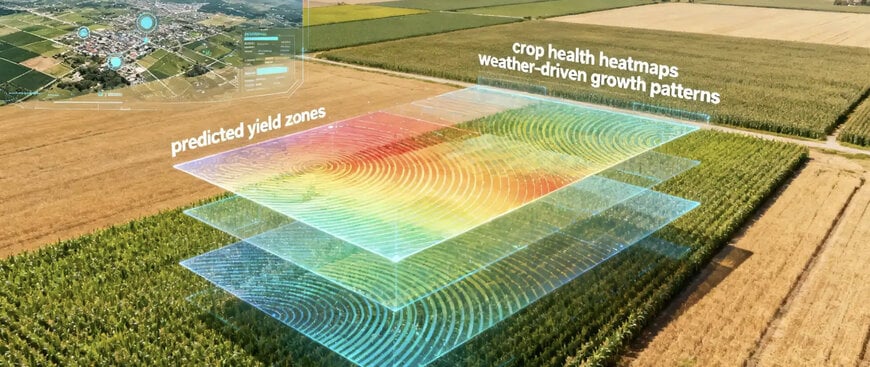
The computational architecture of agricultural artificial intelligence relies on gradient-boosted decision trees and convolutional neural networks. These models ingest high-frequency data pipelines, including 10-meter spatial resolution optical bands from satellites and normalized difference vegetation index values. The algorithms process these inputs against immense historical training volumes; leading platforms ingest trillions of pixel datasets collated over a decade. System latency is minimized by edge-computing integrations and cloud application programming interfaces, delivering field-level harvest projections with error margins frequently below 10 percent, enabling early intervention during critical vegetative stages.
Core Market Challenge
Algorithmic model drift driven by localized microclimatic anomalies and unseasonable pest infestations severely limits predictive confidence. Furthermore, inconsistent ground-truth validation data across fragmented rural plots degrades statistical precision. Limited broadband connectivity in remote regions also inhibits the rapid transfer of high-resolution telemetry and satellite imagery required for continuous model calibration.
Existing Technology Solutions
WiseYield, Cropin, and Bayer deploy distinct engineering strategies for predictive crop yield modeling. Cropin utilizes an extensive global data architecture, processing millions of crop-specific data points to train artificial intelligence models that generate yield forecasts up to 45 days in advance with 90 percent accuracy. Bayer approaches yield forecasting through deep hardware integration; its Climate FieldView platform is active across more than 60 million subscribed hectares globally, utilizing combine-mounted sensors to map harvest mass flow. WiseYield focuses on financial software integration, employing artificial intelligence backends to synthesize weather and optical data to automatically calculate rolling gross margins, tracking variations from 200 euros per hectare for grains up to 10,000 euros per hectare for high-value crops based on predictive yield variables.
Actual implementation on the ground
Cropin implemented its intelligence platform for agricultural enterprises in Nigeria to stabilize regional supply chain planning, analyzing soybean fields to deliver early-warning advisories to growers before crop stress manifested visually. Bayer deploys Climate FieldView to commercial corn and soybean operations throughout North America, layering historical planting data with continuous harvest feedback to evaluate hybrid seed performance across specific field management zones. WiseYield implements its platform by combining localized farm data with external satellite signals, allowing European farm managers to consolidate intelligence and receive automated advisories guiding irrigation timing and chemical application rates directly from the field.
Summary and Strategic Future Outlook
Hybrid architectures coupling mechanistic crop simulation models with physics-informed neural networks will increasingly replace purely statistical regressions. This evolution will enhance multi-season forecasting robustness across variable climates, automating dynamic supply chain operations without human intervention and optimizing global food production networks through advanced precision farming technology.
Edited by Maria Brueva, Induportals editor – adapted by AI.
www.agritechmag.com
