
www.agritechmag.com
17
'26
Written on Modified on
Fendt Tractor Sets Efficiency Record in DLG PowerMix Test
The Fendt 832 Vario achieved a record-breaking fuel consumption of 235 g/kWh, setting new standards for transport and field efficiency under 350 PS.
www.fendt.com
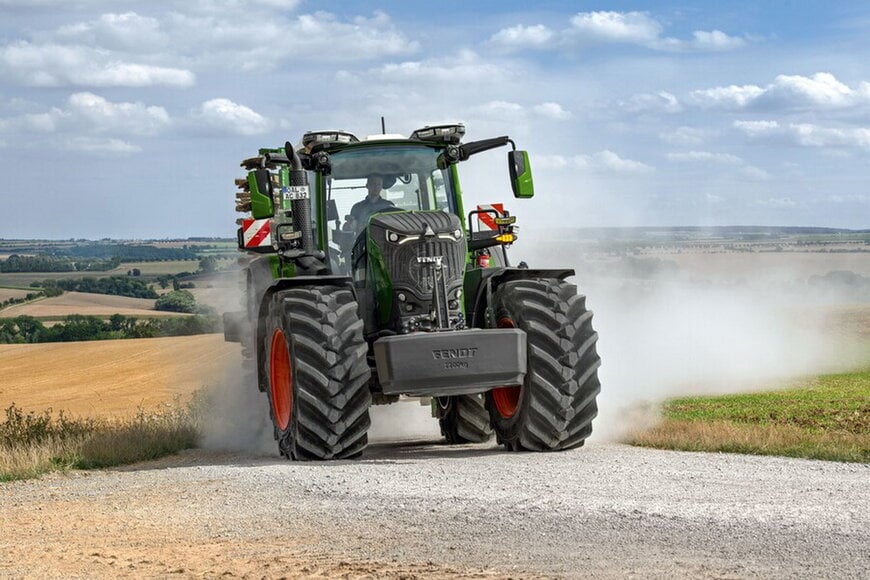
The development of high-performance agricultural machinery requires the integration of high-torque engines with continuously variable transmissions to minimize specific fuel consumption under variable load cycles. In this collaboration, AGCO Power provided the specialized internal combustion engine architecture, while Fendt engineered the vehicle integration, transmission system, and digital control software. The technical objective was to achieve high tractive efficiency and lower fuel consumption across both field and transport operations, addressing the regulatory and economic demand for reduced emissions in heavy-duty machinery.
Drivetrain Integration and Technical Solution
The deployed technical solution consists of an AGCO Power CORE80 7.9-liter, 6-cylinder engine coupled with the Fendt VarioDrive continuously variable transmission. This configuration utilizes the Fendt iD low-speed concept, an engineering approach that manages the engine operating point to deliver high torque at reduced engine speeds.
During standardized technical evaluation on a roller test bench, the system achieved a maximum torque of 1,553 Nm at 1,300 rpm, with a maximum power output of 232 kW. The integration allows the transmission to distribute power dynamically between the front and rear axles without a fixed torque split, reducing internal friction losses and wheel slip during heavy towing operations.
Standardized Performance Evaluation
The integration of these digital infrastructure and mechanical systems was validated through the independent DLG PowerMix 2.0 testing procedure conducted by the German Agricultural Society (DLG) in Groß-Umstadt. This methodology evaluates efficiency using 14 distinct load cycles on a standardized roller test bench, simulating specific operational profiles:
- Twelve cycles replicating field operations, including heavy draft work (plowing and cultivating), power take-off (PTO) utilization, and hydraulic load distribution.
- Two cycles simulating road transport operations.
Operational Results and Use Cases
The tractor series, engineered for a gross vehicle weight of approximately 10 tonnes and a payload capacity of up to 7.6 tonnes, demonstrated measurable efficiency gains under the standardized test cycles. For heavy towing applications, the Fendt 832 Vario recorded an average specific fuel consumption of 245 g/kWh of diesel supplemented by 30 g/kWh of AdBlue. Over the full field-simulation protocol, the average consumption was 235 g/kWh of diesel and 29 g/kWh of AdBlue.
In transport use cases executed at a regulated speed of 60 km/h, the specific consumption was measured at 331 g/kWh of diesel and 36 g/kWh of AdBlue. According to data published in the trade magazine Profi (issue 08/2026), these engineering choices resulted in measured fuel efficiency gains in the high double-digit percentage range compared to the average of equivalent power-class competitors, achieving an improvement exceeding 23 percent during 50 km/h transport cycles. The system utilizes the FendtONE digital infrastructure for automated headland management and lane guidance alongside the VarioGrip tire pressure control system to maintain process stability and reduce soil compaction.
Edited by Evgeny Churilov, Induportals Media - Adapted by AI.
www.fendt.com
The tractor series, engineered for a gross vehicle weight of approximately 10 tonnes and a payload capacity of up to 7.6 tonnes, demonstrated measurable efficiency gains under the standardized test cycles. For heavy towing applications, the Fendt 832 Vario recorded an average specific fuel consumption of 245 g/kWh of diesel supplemented by 30 g/kWh of AdBlue. Over the full field-simulation protocol, the average consumption was 235 g/kWh of diesel and 29 g/kWh of AdBlue.
In transport use cases executed at a regulated speed of 60 km/h, the specific consumption was measured at 331 g/kWh of diesel and 36 g/kWh of AdBlue. According to data published in the trade magazine Profi (issue 08/2026), these engineering choices resulted in measured fuel efficiency gains in the high double-digit percentage range compared to the average of equivalent power-class competitors, achieving an improvement exceeding 23 percent during 50 km/h transport cycles. The system utilizes the FendtONE digital infrastructure for automated headland management and lane guidance alongside the VarioGrip tire pressure control system to maintain process stability and reduce soil compaction.
Edited by Evgeny Churilov, Induportals Media - Adapted by AI.
www.fendt.com
