
www.agritechmag.com
08
'26
Written on Modified on
CLAAS Commercializes TORION 537e SINUS Battery-Electric Wheel Loader
CLAAS has launched the TORION 537e SINUS, its initial production-ready, six-tonne-class battery-electric telescopic wheel loader engineered for livestock farming and material handling.
www.claas.com
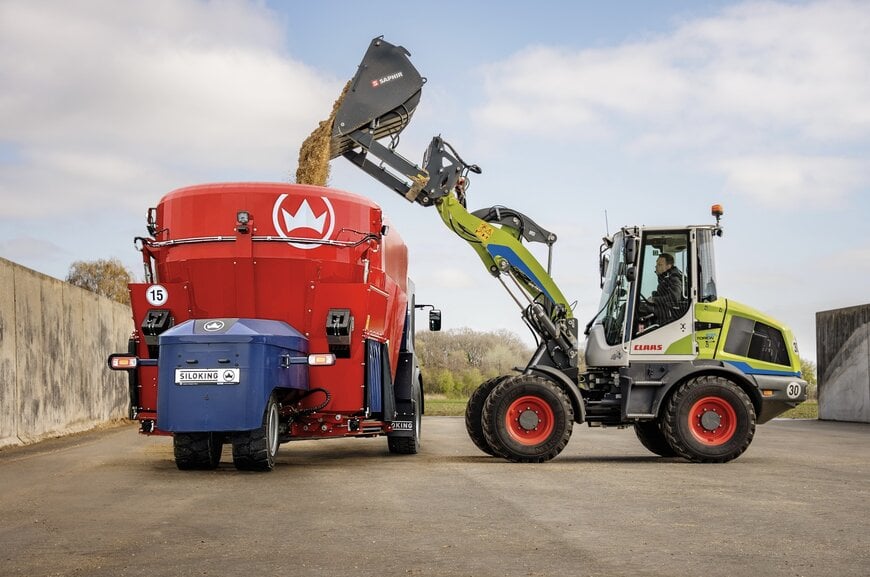
Following its world debut at the Agritechnica 2025 exhibition, the new battery-electric TORION 537e SINUS telescopic wheel loader from CLAAS has entered its commercial distribution phase. The compact, six-tonne-class machine integrates the manufacturer's mechanical SINUS steering geometry with an emission-free electric drivetrain and an integrated on-board charging system, matching the performance profiles of conventional, diesel-powered loaders.
Powertrain Architecture and Charging Parameters
The TORION 537e SINUS substitutes the standard internal combustion engine and hydrostatic transmission configuration of the conventional TORION 537 SINUS with a dedicated battery-electric drive block. The machine is built on a modular lithium-ion energy storage system operating at an average voltage of 322 V. The electrical infrastructure is available in two capacities: a baseline 32.2 kWh battery module and an optional 64.4 kWh configuration.
During material handling cycles, the battery distributes power using a standalone dual-motor topology, supplying up to 30 kW to the ground drive assembly and 15 kW to the main hydraulic pump. This configuration yields a continuous operating duration ranging from 8 to 16 hours, depending on the integrated battery capacity. To optimize energy usage, the machine employs a regenerative braking protocol that converts kinetic energy back into electricity during deceleration and downhill operations, replenishing the cell blocks.
The integrated on-board charging infrastructure supports flexible plug-in connections directly to standard electrical grids without requiring separate external charging hardware. When connected to a standard 400 V, 32 A industrial power source, the baseline 32.2 kWh battery pack can be charged from 20% to 80% capacity within 0.8 hours.
Technical Performance and Cabin Ergonomics
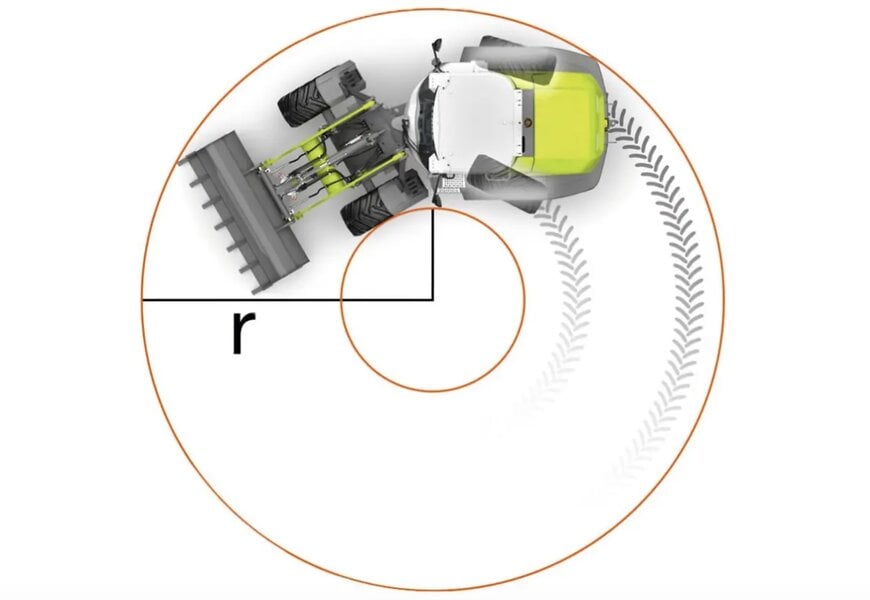
The loader achieves maximum travel speeds of up to 30 km/h. To preserve handling capabilities in confined environments, the machine incorporates the proprietary SINUS steering platform, which combines articulated central frame steering with a mechanically synchronized, self-steering rear axle. This dual-steering architecture delivers high maneuverability alongside enhanced lateral stability and elevated tipping load margins. The machine's workspace includes a sound-insulated comfort cab that limits internal acoustic noise levels to 65 dB(A). The operating station features a right-mounted, touchscreen display terminal that centralizes machine diagnostics, active task telemetry, and real-time charging metrics, including current state-of-charge percentages and remaining time-to-charge projections.
For automated loading tasks, the vehicle integrates the standard SMART LOADING assistance system. This digital framework automates repetitive loading cycles by precisely coordinating hydraulic functions, allowing operators to pre-program specific lift height limits, lowering height markers, and automated bucket return positions to optimize cycle times.
Digital Fleet Management and Warranty Frameworks
The vehicle incorporates cellular data transceivers to link directly into the cloud-based CLAAS connect ecosystem via a personalized machine identification framework. The digital platform provides fleet operators with real-time access to physical asset tracking, localized position coordinates, active operating parameters, and automated maintenance records. The system provides online access to specialized lubricant guides, digitized technical operating manuals, and direct ordering channels within the vendor's spare parts network to support predictive service scheduling.
To hedge ongoing equipment overhead, the manufacturer provides tailored MAXI CARE service coverage tiers:
- MAXI CARE Focus: A complimentary component warranty extension that covers the 322 V high-voltage battery system for a period of five years or 6,000 operational hours. The terms guarantee a minimum residual battery capacity of 80% at the conclusion of the warranty window, provided a concurrent five-year authorized maintenance contract is established.
- MAXI CARE Flex / Protect: Extended protection plans that span up to eight years or 8,000 operational hours, covering component failures, genuine replacement parts, necessary workshop consumables, and full mechanical repair labor.
Regional acquisition or leasing of the climate-friendly machinery is supported by localized government subsidy frameworks and industrial low-interest funding models, such as Germany’s Landwirtschaftliche Rentenbank credit program. While new applications under this specific federal energy efficiency funding framework were suspended, registrations are scheduled to resume starting in the fourth quarter of 2026.
Additional Context
This section details technical specifications not included in the original news release.
The mechanical implementation of the dual-steering SINUS system utilizes an explicit physical linkage connecting the front articulated chassis joint to the rear steering knuckles. When the central hydraulic steering cylinders articulate the front frame up to its maximum 30-degree pivot angle, the mechanical transmission rod forces the rear axle wheels to steer in the opposite direction at a proportional angle up to 25 degrees. This simultaneous steering layout lowers the absolute turning radius measured over the outer tire boundary to 3,520 mm. Because the rear wheels track the path of the front frame, the center of gravity remains securely aligned along the vehicle's longitudinal axis, preventing the drastic reduction in lateral tipping capacity that occurs when standard articulated loaders are turned at full lock.
The low-noise working hydraulics depend on a high-capacity main hydraulic pump that delivers a fluid volume flow rate of 75 liters per minute at a peak system operating pressure of 240 bar. This fluid output feeds a rigid, torsion-resistant Z-bar kinematics lift arm assembly configured to maximize structural breakaway force up to 48 kN at the attachment edge. The high fluid velocity, combined with the instantaneous torque output of the independent 15 kW hydraulic electric motor, allows the system to execute a full lift cycle in 4.9 seconds, a tipping dump cycle in 1.7 seconds, and a gravity-assisted lowering cycle in 3.5 seconds. The independent electric drive configuration completely uncouples hydraulic processing power from the ground travel speed, permitting high hydraulic speed and lift forces while the vehicle crawls forward at low speeds during delicate material dosing or livestock feeding tasks.
Edited by Romila DSilva, Induportals Editor, with AI assistance.
Additional Context
This section details technical specifications not included in the original news release.
The mechanical implementation of the dual-steering SINUS system utilizes an explicit physical linkage connecting the front articulated chassis joint to the rear steering knuckles. When the central hydraulic steering cylinders articulate the front frame up to its maximum 30-degree pivot angle, the mechanical transmission rod forces the rear axle wheels to steer in the opposite direction at a proportional angle up to 25 degrees. This simultaneous steering layout lowers the absolute turning radius measured over the outer tire boundary to 3,520 mm. Because the rear wheels track the path of the front frame, the center of gravity remains securely aligned along the vehicle's longitudinal axis, preventing the drastic reduction in lateral tipping capacity that occurs when standard articulated loaders are turned at full lock.
The low-noise working hydraulics depend on a high-capacity main hydraulic pump that delivers a fluid volume flow rate of 75 liters per minute at a peak system operating pressure of 240 bar. This fluid output feeds a rigid, torsion-resistant Z-bar kinematics lift arm assembly configured to maximize structural breakaway force up to 48 kN at the attachment edge. The high fluid velocity, combined with the instantaneous torque output of the independent 15 kW hydraulic electric motor, allows the system to execute a full lift cycle in 4.9 seconds, a tipping dump cycle in 1.7 seconds, and a gravity-assisted lowering cycle in 3.5 seconds. The independent electric drive configuration completely uncouples hydraulic processing power from the ground travel speed, permitting high hydraulic speed and lift forces while the vehicle crawls forward at low speeds during delicate material dosing or livestock feeding tasks.
Edited by Romila DSilva, Induportals Editor, with AI assistance.
