
www.agritechmag.com
19
'26
Written on Modified on
Aerial spraying drones maximize precision in localized crop protection
New Holland has introduced an autonomous aerial atomization system to facilitate localized fluid application on complex and inaccessible agricultural fields.
www.newholland.com
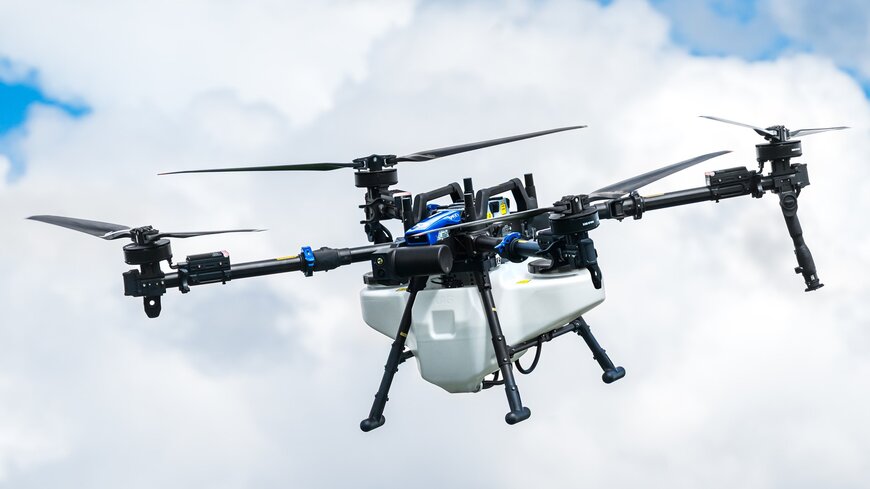
The integration of large-scale unmanned aerial vehicles into seasonal crop protection workflows addresses the logistical constraints of traditional machinery. Conventional ground-based spraying methods encounter critical mobility boundaries when traversing waterlogged soils, steep inclines, or dense crop canopies, where heavy wheel tracking compacts subsoil layers and shears standing vegetation.
To maintain consistent agrochemical distribution without relying on heavy machinery traffic, an automated aerial platform utilizing high-capacity centrifugal atomization mechanisms has been engineered.
Kinematics of autonomous flight and centrifugal atomization parameters
The structural architecture of the spraying drone integrates a reinforced fluid reservoir with a maximum payload capacity of 70 liters. The mechanical dispersion system is calibrated to achieve an effective working swath width extending up to 10 meters. The system utilizes rotary centrifugal atomizers that allow operators to modulate droplet diameters between 60 and 500 micrometers. This targeted adjustment optimizes canopy penetration while mitigating the hazards of crosswind drift.
Fluid delivery is driven by a series of high-output flexible impeller pumps capable of maintaining a maximum spraying flow rate of 30 liters per minute. This specific kinematic deployment ensures uniform application density across heterogeneous topographies. The downward aerodynamic wash generated by the rotors forces the atomized droplets directly into the lower crop canopy and onto the underside of leaf structures. The official commercial commissioning of this aerial platform occurred at the AgroActiva exhibition in June 2026, establishing a standardized method for mid-season field interventions.
Comprehensive field evaluations conducted across active commercial acreage confirmed that the platform can execute targeted variable-rate application sequences without causing physical soil compaction or tire-track crop loss, eliminating the operational delays that normally follow heavy precipitation events.
Battery thermomechanical infrastructure and real-time three-dimensional mapping
The electrical propulsion loop relies on an array of intelligent battery modules utilizing high-density lithium chemistries paired with automated fast-charging electronics to minimize ground-handling turnaround times. The onboard charging interface incorporates an active liquid-cooling heat exchanger designed to dissipate thermal accumulation generated during rapid high-current replenishment cycles, preventing localized hot spots and maintaining chemical cell stability under high ambient temperatures.
Autonomous navigation and flight-path corrections are managed by an integrated high-throughput flight controller that processes real-time kinematic differential positioning telemetry for centimeter-level geometric tracking. Collision avoidance and obstacle detection are secured by a long-range 4D imaging radar array combined with millimeter-wave sensors, allowing the drone to maintain precise terrain-following accuracy down to specified canopy offsets during both day and night operational schedules.
The control software includes an automated three-dimensional mapping algorithm that synthesizes topographic data directly during flight. This localized digital elevation modeling automates path planning along complex boundary definitions, enabling the seamless transfer of application logs and rate telemetry into central farm management databases to satisfy environmental traceability audits.
Additional Context: This section details technical specifications and competitive benchmarking not included in the original product announcement.
In the global agricultural unmanned aerial vehicle sector, 70-liter payload platforms compete directly with established configurations such as the DJI Agras series and specialized autonomous aircraft manufactured by XAG. Objective material benchmarks indicate that the integration of standard rotary centrifugal atomizers in this architecture minimizes nozzle clogging caused by suspended crystalline particulates, lowering preventive maintenance intervals relative to pressure-nozzle designs.
While common industrial alternative models depend on pre-mapped terrain files or extensive external base station setups to navigate sharp elevation changes, the inclusion of integrated 24 GHz terrain-radar sensors allows this system to actively trace canopy gradients in real time.
However, the large physical footprint of a deployed 70-liter aircraft demands a structured field-logistics framework for battery transportation and high-output generation equipment on the ground, representing a higher baseline support equipment requirement than smaller utility drones or conventional lightweight spray booms.
Edited by Sucithra Mani, Induportals editor – adapted by AI.
www.newholland.com
