
www.agritechmag.com
17
'26
Written on Modified on
LEMKEN Introduces Saphir XMR Mechanical Seed Drill Series
The new seed drill builds on the strengths of the previous series while setting new standards for precision, ease of use, and area coverage.
lemken.com
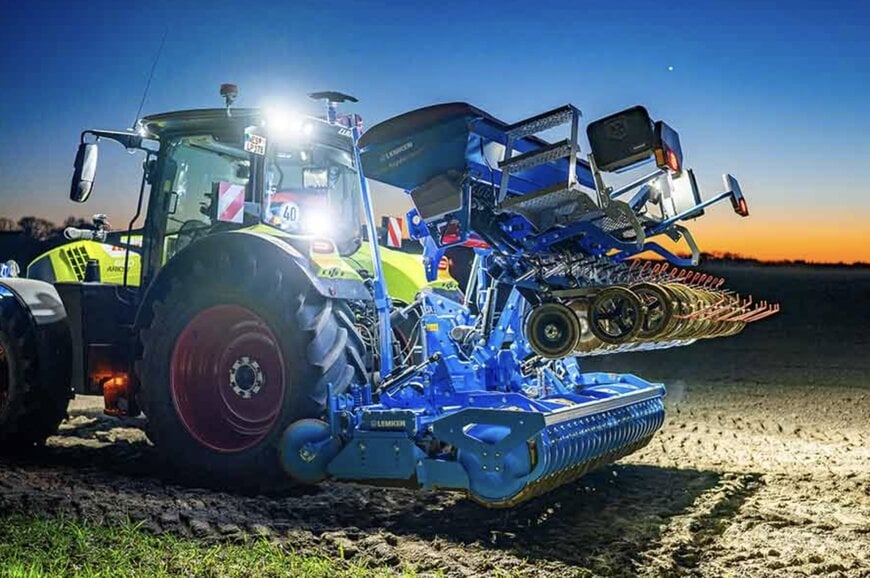
LEMKEN has introduced the Saphir XMR mechanical seed drill as the official successor to the Saphir 10 series. The newly developed agricultural implement builds upon its predecessor's core operational capabilities while integrating updates to precision metering, operator handling, and field area coverage.
Reengineered Metering System and Section Control
At the core of the Saphir XMR is a completely redesigned metering system engineered to optimize seed delivery and simplify machine maintenance. The individual metering wheels are designed to be removed manually without the use of tools, allowing farm operators to switch rapidly between different seed varieties or execute routine cleaning and maintenance procedures. The system utilizes multiple specialized seed wheel profiles to ensure that both small, fine seeds and larger seed types are distributed precisely and evenly down the seed rows.
As a standard factory specification, the drill incorporates a double-sided electric drive working in tandem with an integrated half-width section switching system. By restricting seed distribution overlap at headlands or within irregularly shaped field boundaries, this configuration minimizes unnecessary seed waste and lowers overall input costs during planting operations.
Mechanical Controls and Operator Adjustments
The design of the Saphir XMR incorporates simplified mechanical adjustments to facilitate rapid adaptation to changing field conditions. Working depth parameters are set via a single central lever assembly, while the individual coulter pressure and specific sowing depth settings can be modulated independently of one another.
For field transit planning, the platform utilizes a patented tramline control system developed to maximize row flexibility. This hardware allows operators to select and implement diverse tramline patterns and customized working widths from the tractor cab. The implement leverages the iQblue drill operating system, an ISOBUS-compliant control architecture that gives operators logical and clear access to all primary machine functions. Depending on the final model specification selected, technical tasks such as formal calibration testing or residual tank emptying are fully managed via integrated digital support software.
To achieve consistent seed placement, the drill relies on parallelogram-guided double disc coulters paired with dedicated trailing depth control and pressure rollers. This mechanical assembly maintains a uniform seeding depth and consistent seed-to-soil contact under variable field topographies and at accelerated ground speeds, promoting uniform crop emergence across the row grid. The tool's row-pressure grid mechanism allows the total coulter force to be adjusted up to 45 kilograms. The mechanical seed drill series maintains standard row spacing options manufactured at either 12.5 or 15 centimeters.
Tank Capacities and Power Harrow Integration
To cover large agricultural fields during extended operational intervals, the Saphir XMR series is manufactured with three separate bulk hopper capacities: 900, 1,200, or 1,500 liters. The wide hopper opening is fitted with a rigid, waterproof plastic lid configured to streamline filling operations via large bulk seed bags or front-loading farm machinery. Additionally, the equipment can be fitted with an optional 200-liter MultiHub auxiliary tank developed to handle micro-granules or concurrent catch crop sowing.
The Saphir XMR is engineered to function as a high-performance machinery combination when combined with the Zirkon EMR or Zirkon XMR power harrows. For this coupled setup, the company has introduced a new 600-series packer roller developed to lower overall rolling resistance and enhance soil reconsolidation, particularly when operating on lighter soil conditions. Utilizing a semi-mounted implement architecture, the combination uses integrated hydraulic cylinders to simultaneously lift and swivel the seed drill forward toward the tractor. This swiveling movement lowers the total rear axle load and stabilizes the vehicle's dynamic weight distribution, protecting steering parameters during high-speed road transport.
Additional Context
This section details technical specifications not included in the original news release.
Mechanical seed drills rely on precise gravity-fed and volumetric metering systems to maintain target seed populations per hectare. To ensure uniform seed distribution across varying field gradients and travel speeds, the implement's electronic section control integrates with a specialized radar sensor or the tractor's GNSS speed logging feed. The dual-sided electric drive uses independent step motors or high-torque brushless DC motors to turn separate halves of the main metering shaft. By dynamically engaging or disengaging these motors via ISOBUS Task Controller Section Control (TC-SC) protocols, the system isolates half of the working width when crossing a previously seeded field boundary, minimizing seed crowding and row competition.
The mechanical stability of seed placement at high speeds depends on the dampening characteristics of the coulter assembly. Parallelogram guidance mechanisms utilize a four-bar linkage geometry that isolates the double disc coulter from vertical tractor and frame pitching. This layout keeps the angle of attack of the rotating discs constant relative to the soil surface, preventing depth variations.
The depth control pressure roller applies localized mechanical pressure immediately behind the disc opener, packing loose soil around the dropped seed to eliminate air pockets. This physical compression optimizes capillary action within the upper soil layer, drawing moisture toward the seed coat to accelerate germination and maximize early root development.
Edited by Romila DSilva, Induportals Editor, with AI assistance.
www.lemken.com
