
www.agritechmag.com
27
'26
Written on Modified on
High Efficiency Optical Solid State Systems for Controlled Agriculture
ams OSRAM to exhibit advanced light-emitting diode systems for precision plant growth and environmental optimization at GreenTech Amsterdam.
ams-osram.com
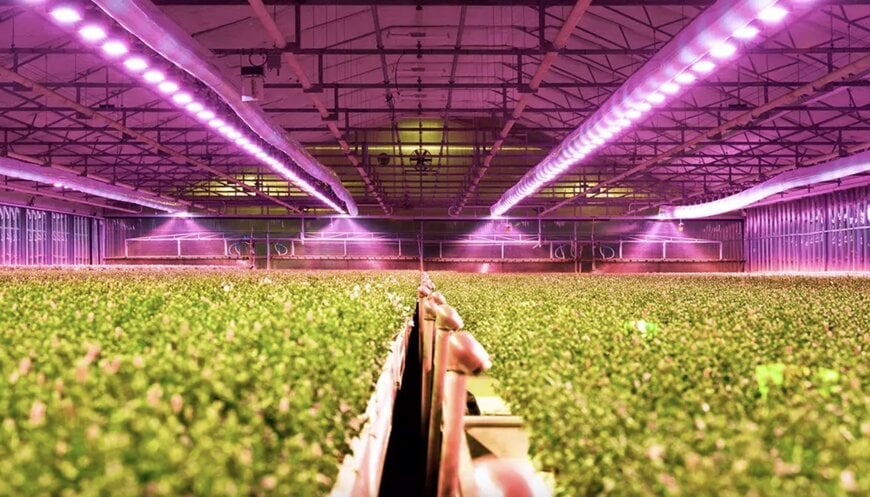
The implementation of targeted light emitting diode technologies serves as a foundational component in modern agricultural engineering and professional turf management. The interaction between plants and light sources relies heavily on precise spectral composition, photon flux density, and geographic uniformity rather than basic ambient illumination. To address these biological requirements, integrated semiconductor lighting ecosystems are being deployed to accelerate photosynthesis, optimize plant root structures, and stabilize crop cycles within modern greenhouses and athletic facilities where natural exposure is constrained.
Spectral Engineering and Semiconductor Efficiency Performance
Developing resilient vegetation, such as professional sports turf or greenhouse crops, requires high photon flux combined with optimized system energy consumption. The deployment of the OSCONIQ P 3737 Gen 3 high-power light emitting diode addresses this challenge by delivering specialized spectral outputs designed for professional top lighting. For instance, the Hyper Red variant operates with a wall-plug efficiency of 83.6 percent at an operating junction temperature of 85 degrees Celsius. This measurable thermal and electrical stabilization allows luminaire manufacturers to decrease individual component counts or reduce overall aggregate power demands while maintaining high localized photosynthetic photon flux.
To achieve robust plant development across massive surface areas, spatial distribution must minimize shadows and thermal hot spots. Optical variants engineered with dedicated wide-angle radiation profiles, such as the OSCONIQ P 3737 Batwing, rely on integrated secondary lenses to produce homogeneous light projection. By increasing spatial beam uniformity, these architectural optics minimize plant stress and ensure consistent biomass generation across playing fields and intensive agricultural installations, significantly lowering the total number of physical fixtures required per installation area.
Environmental Control and Contactless Crop Protection Systems
Beyond standard vegetative growth, short-wavelength solid-state lighting helps regulate crop quality and mitigate pathogen exposure without chemical additions. Integrated ultraviolet-C light emitting diode systems provide continuous germicidal disinfection across irrigation water, facility air streams, and hardware surfaces. This localized radiation profile limits the reproduction of plant diseases and harmful micro-organisms, lowering the operational dependency on chemical pesticides inside controlled environment agriculture facilities.
Complementing these ultraviolet disinfection systems, specialized contactless weed management technologies are changing traditional field maintenance. Leveraging blue laser diodes, these concepts provide targeted thermal eradication of competitive weeds without disturbing topsoil or applying synthetic herbicides. The combination of these optical tools establishes an integrated technical framework that supports sustainable, precise crop cultivation and turf maintenance from initial root development to terminal post-harvest storage.
Industrial Showcase and Global Supply Integration
The practical application of these solid-state lighting portfolios will be demonstrated at the upcoming GreenTech Amsterdam exposition, taking place from June 9 to 11, 2026, in Amsterdam, Netherlands. Situated in Hall 5, Booth 05.309, ams OSRAM will exhibit its full agricultural semiconductor ecosystem, including the OSCONIQ P 3737 Gen 3, the specialized Batwing optical platforms, and advanced laser disinfection components. This industrial venue highlights how foundational lighting advancements translate directly into stable commercial solutions backed by established patent protection and verified global hardware supply chains.
Additional Context
This section details technical specifications and competitive benchmarking not included in the original news release.
Industrial horticultural lighting is evaluated using specific benchmark criteria defined by the DesignLights Consortium and the American Society of Agricultural and Biological Engineers, focusing on Photosynthetic Photon Efficacy measured in micromoles per Joule. Conventional ceramic-based high-power horticulture light emitting diodes from competitors like Samsung (with the LH351B series) and Cree LED (with the XLamp XP-G3) generally operate with photosynthetic efficacies hovering between 3.2 and 3.6 per Joule under typical operating currents of 700 milliamperes.
The architectural consolidation implemented in the OSCONIQ P 3737 series introduces an epoxy-based molded lead frame package that expands the semiconductor chip footprint beyond traditional 2 millimeter by 2 millimeter standards to a larger 3.7 millimeter by 3.7 millimeter platform. This physical modification permits the inclusion of a larger silicone primary lens, which drastically improves internal light extraction efficiency and raises the overall radiant flux to 1,113 milliwatts at an ambient temperature of 25 degrees Celsius. By maintaining a radiant efficiency of 83.2 percent at room temperature and scaling smoothly to 80.6 percent under sustained operational heat loads of 85 degrees Celsius, this chip configuration enables commercial luminaire designs to exceed a performance baseline of 4.0 per Joule, creating a measurable gap in system-level output density relative to legacy ceramic configurations.
Edited by Romila DSilva, Induportals Editor, with AI assistance.
www.ams-osram.com
