
www.agritechmag.com
26
'26
Written on Modified on
New Holland Combine Advances Agricultural Research
New Holland supplies the University of Hohenheim with a CR 7.90 combine harvester for crop research, teaching and field trials.
www.cnh.com
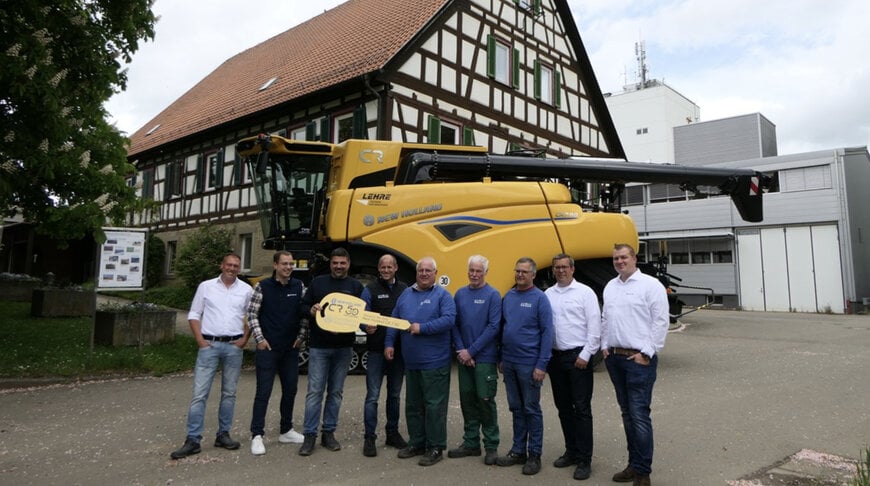
New Holland has delivered a CR 7.90 combine harvester to the agricultural research stations of the University of Hohenheim in Germany, where the machine will support scientific studies, agricultural engineering research and practical field testing. The combine will primarily operate at the Ihinger Hof research station while contributing to crop production and digital agriculture projects across the university’s research network.
Precision harvesting technologies support crop analysis
The University of Hohenheim, one of Europe’s established agricultural science institutions, conducts research in plant production, agricultural engineering, digitalization and sustainable land management. For experimental field plots, harvesting equipment capable of generating reproducible and measurable crop data is increasingly important.
The CR 7.90 incorporates New Holland’s Twin Rotor threshing system, designed to separate grain while minimizing crop damage during harvesting. The machine also includes IntelliSense combine automation with an integrated grain quality camera that automatically adjusts settings to optimize grain cleanliness.
Automated harvesting systems have become more relevant in precision agriculture, where sensor-based optimization can improve consistency across varying crop and field conditions.
Integrated NIR sensing enables real-time crop quality measurement
A key feature for research applications is the combine’s integrated Near-Infrared (NIR) sensing technology. According to the University of Hohenheim, the system measures crop quality parameters including moisture, protein and starch content directly during harvesting.
Real-time NIR analysis reduces dependence on separate laboratory testing by generating immediate datasets for crop evaluation, enabling faster interpretation of field trial outcomes. Such capabilities are increasingly used in agricultural research and precision farming workflows where continuous quality monitoring is required.
Track systems target reduced soil compaction
The combine is equipped with the SmartTrax track system, developed to improve traction while minimizing soil compaction. Reducing compaction is important in experimental plots because changes in soil structure can influence crop growth and affect repeatability across trials.
The machine is also paired with an updated 9 m VariFeed header, providing flexibility across different crop types and harvesting conditions.
Research infrastructure supports applied agricultural innovation
The agricultural research stations of the University of Hohenheim include seven operational sites across Baden-Württemberg, supporting applied studies throughout the agricultural value chain. The CR 7.90 will be integrated into these research activities following the university’s previous use of earlier-generation New Holland combine technology.
According to representatives from Schreier Landtechnik and New Holland, prior operational experience with earlier CR combines contributed to the selection of the new model for ongoing research requirements.
Additional Context:
This section details technical specifications and competitive benchmarking not included in the original product announcement
The CR 7.90 competes with high-capacity combines such as the Claas LEXION 7700 and John Deere X9 series, with benchmark criteria typically including grain throughput, fuel efficiency, grain loss rates and automation capabilities. Unlike conventional combines relying primarily on manual adjustments, IntelliSense automation continuously optimizes harvesting parameters using sensor inputs.
Integrated NIR technology is also available in comparable systems from manufacturers including John Deere and Claas, enabling in-field measurement of crop properties such as moisture and protein. The differentiating factor is often the level of automation integration with harvesting controls rather than sensing capability alone.
Track systems such as SmartTrax are increasingly adopted across high-capacity combines due to their ability to reduce ground pressure compared with wheeled configurations, supporting soil preservation in both commercial farming and experimental research environments.
Edited by Natania Lyngdoh, Induportals editor, assisted by AI.
www.cnh.com
