
www.agritechmag.com
14
'26
Written on Modified on
Mitsubishi Electric Develops Soil Carbon Estimation Technology
Optical sensing and soil carbon modeling aim to improve agricultural monitoring and greenhouse gas reporting.
www.mitsubishielectric.com
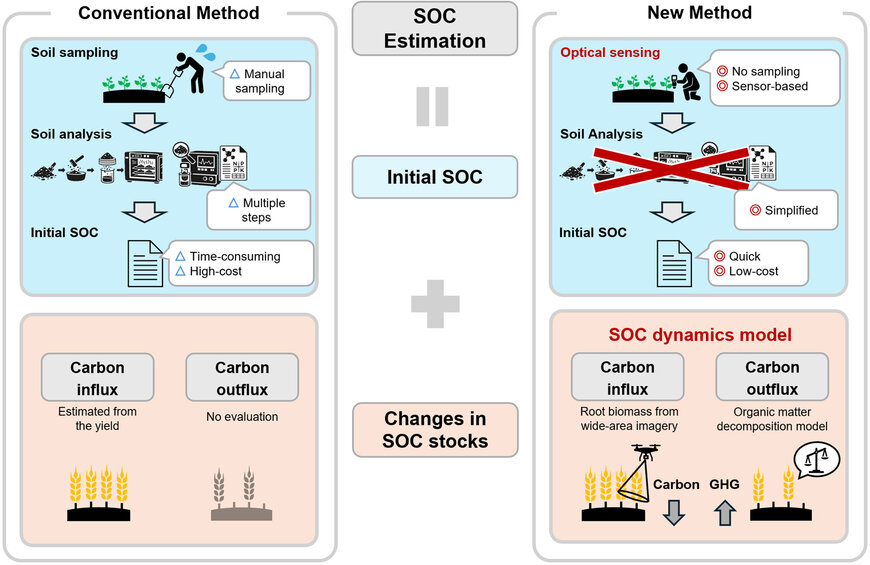
Mitsubishi Electric Corporation has developed a technology for estimating soil organic carbon in agricultural land using optical measurements combined with soil organic carbon dynamic models. The system integrates aerial remote sensing, ground-based optical sensing, and simulation models to estimate soil carbon levels without requiring large-scale soil sampling or laboratory chemical analysis.
The technology is intended to support low-cost and large-area monitoring of soil organic carbon in agricultural environments, particularly as governments and agricultural sectors expand carbon accounting and greenhouse gas reduction programs.
Soil organic carbon monitoring for agricultural decarbonization
Soil organic carbon plays an important role in agricultural productivity and carbon sequestration. Higher SOC levels can improve soil fertility, increase water retention, and contribute to reduced greenhouse gas emissions by storing carbon within agricultural soils.
Monitoring SOC has become increasingly important as countries implement carbon reduction policies and emissions trading frameworks linked to agriculture and land management. In Japan, these activities are expected to support the GX-ETS greenhouse gas emissions trading system, scheduled for full operation by the fiscal year ending March 2027.
Conventional SOC monitoring methods typically require extensive physical soil sampling and laboratory analysis because soil carbon levels are strongly affected by biological and chemical processes such as microbial decomposition and plant root growth.
Combining optical sensing with carbon dynamics models
Mitsubishi Electric’s technology combines optical measurements with two soil organic carbon dynamic models: a root biomass model and a microbially mediated organic matter decomposition model.
The root biomass model estimates changes in soil carbon and nutrient levels by analyzing plant root growth and biomass development. The microbial decomposition model predicts rates of organic matter breakdown and associated carbon emissions caused by microbial activity within soil systems.
According to the company, aerial remote sensing data and ground-based optical measurements are processed through these simulation models to reproduce soil organic carbon dynamics across agricultural land.
By reducing dependency on direct sampling and laboratory testing, the system is intended to support wider-area monitoring with lower operational cost and reduced labor requirements.
Demonstration in Hokkaido agricultural fields
Mitsubishi Electric conducted a field demonstration in Toyotomi-cho, Hokkaido, Japan, where the company stated that the technology achieved improved estimation accuracy compared with conventional approaches while enabling large-area evaluation of soil carbon conditions.
The system is also intended to support monitoring, reporting, and verification workflows used within carbon accounting frameworks. According to the company, generated data can provide objective evidence for third-party verification processes associated with emissions reduction reporting under GX-ETS.
MRV systems are becoming increasingly important within agricultural carbon programs because accurate and verifiable data is required for emissions credit generation, regulatory compliance, and sustainability reporting.
Remote sensing and carbon accounting in agriculture
Remote sensing technologies are increasingly being integrated into agricultural carbon monitoring systems because they enable scalable environmental assessment across large land areas without requiring intensive manual sampling.
Comparable approaches in agricultural carbon monitoring often combine satellite imaging, multispectral sensing, machine learning, and soil simulation models to estimate carbon storage, crop conditions, and land-use changes.
The growing use of carbon accounting systems within agriculture is also linked to broader sustainability targets and efforts to reduce greenhouse gas emissions across food production and land management sectors.
Mitsubishi Electric stated that it plans to conduct additional demonstrations across different agricultural environments in Japan and internationally to further validate the technology and support carbon-neutral agricultural practices.
Edited by Natania Lyngdoh, Induportals editor, with AI assistance.
www.mitsubishielectric.com
