
www.agritechmag.com
03
'26
Written on Modified on
Seed Treatment Blender Expands Pacific Northwest Capacity
CHS Inc. installs a new blending system in Rockford, Washington, to enhance customized seed treatment services for regional cereal and specialty crop growers.
www.chsinc.com
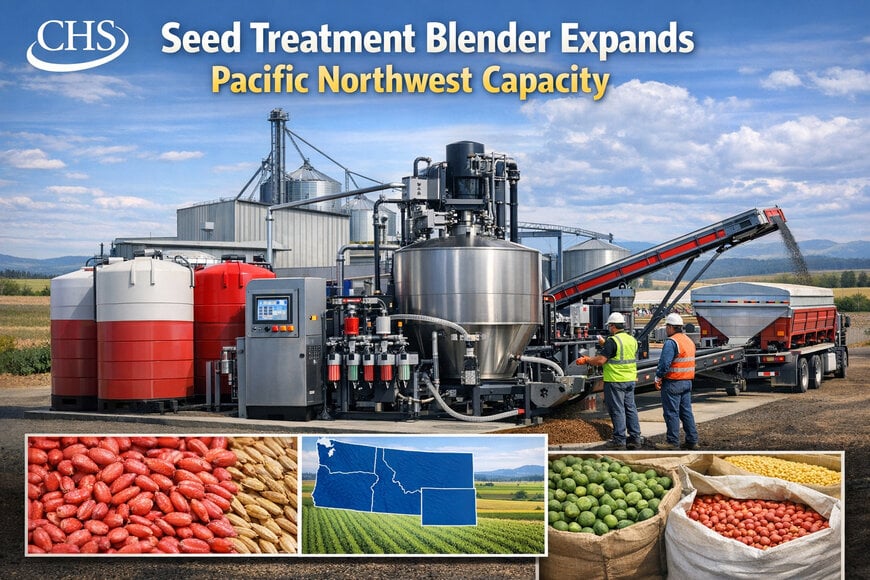
CHS Inc. has commissioned a new seed treatment blender at its Rockford, Washington facility, expanding its seed applied technologies capacity in the Pacific Northwest. The system supports customized seed treatment formulations for cereal crops and specialty markets, including large-seeded vegetables, with a focus on regional agronomic conditions.
Regional Agronomy and Application Scope
The Rockford installation represents the fifth blender added to the company’s STI (seed treatment inoculant) customized blending service since 2011. The expansion is designed to serve growers across Washington, Idaho, Oregon and Montana, where early-season disease pressure, insect activity and variable soil conditions can significantly influence stand establishment and yield potential.
Seed treatment blending systems meter and combine active ingredients such as fungicides, insecticides and biological inoculants into crop-specific formulations. For cereal crops and large-seeded vegetables, accurate dosing and uniform coating are critical to ensure consistent seed coverage, minimize active ingredient waste and comply with label application rates. By locating blending capacity closer to production regions, CHS aims to reduce lead times and improve logistical reliability within the regional digital supply chain for crop inputs.
Technical Rationale for On-Site Blending
Seed treatment is typically applied prior to planting to protect seedlings during germination and early vegetative stages, when crops are most vulnerable to soil-borne pathogens and early insect feeding. Custom blending allows adaptation of treatment packages to local cropping systems, target pest spectra and environmental conditions such as soil temperature and moisture.
According to Blake Murnan, director of seed applied technologies at CHS, the Rockford investment increases formulation flexibility and precision in a region where cropping diversity requires tailored solutions. The system supports both agronomy retail operations and wholesale customers, expanding access to treatment combinations from multiple crop protection partners.
By increasing blending capacity at the Rockford site, CHS can respond more rapidly to seasonal demand fluctuations. Regionalized blending also reduces dependency on centralized facilities, which can be a constraint during peak planting windows.
Integration with Agronomy Operations
The new blender complements CHS’s broader agronomy services portfolio, which includes crop input distribution, grain marketing and risk management. As the largest farmer-owned cooperative in the United States, CHS reported revenues of $35.5 billion in fiscal year 2025 and serves customers in 65 countries.
In practical terms, the Rockford installation strengthens service continuity for growers seeking customized seed treatments aligned with local agronomic challenges. For producers of cereals and specialty crops, earlier and more precise seed protection can contribute to improved stand uniformity and yield stability under variable field conditions.
www.chsinc.com
