
www.agritechmag.com
02
'26
Written on Modified on
Agricultural Drones for Precision Farm Operations
Elders has demonstrated multi-function agricultural drones in Western Australia to support data-driven crop management, input efficiency, and mechanised farm operations.
elders.com.au
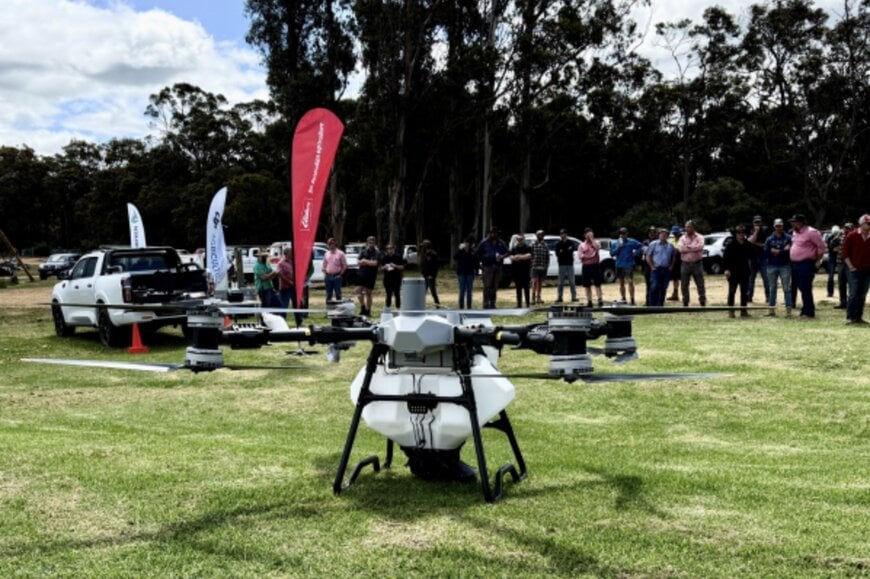
Elders has conducted a series of regional demonstrations in Western Australia highlighting the use of agricultural drones for spraying, spreading, lifting, and mapping applications in broadacre farming.
Expanding the role of drones in farm operations
The demonstration events, held across Esperance, Albany and Geraldton, presented a range of agricultural drones designed for mapping, spraying and spreading tasks. According to Elders, the events generated strong interest from growers and resulted in multiple sales, indicating growing adoption of drone-based systems for on-farm operations.
The centrepiece of the demonstrations was a high-capacity agricultural drone designed to support multiple functions within a single platform. The system combines liquid spraying, granular spreading and lifting capabilities, allowing operators to use one aerial platform for several input and logistics tasks. This approach addresses common constraints in broadacre agriculture, including labour availability, time-critical input application, and the need for consistent coverage across large paddocks.
Technical relevance for precision agriculture
From a technical perspective, multi-function agricultural drones are increasingly relevant due to their ability to apply inputs with controlled application rates and spatial accuracy. Spraying and spreading operations benefit from GPS-guided flight paths and predefined application zones, which help reduce overlap, minimise wastage, and improve input efficiency. These characteristics align with broader trends in precision agriculture and the digital supply chain, where accurate execution and traceable application data are critical.
In addition to input application, lifting functionality enables drones to transport small payloads such as tools or materials to hard-to-access areas, reducing manual handling and non-productive travel time for farm staff.
Integration of drone mapping into agronomic advisory services
Beyond field operations, Elders’ agronomy team is progressing training programs to integrate drone-based mapping into paddock assessments and advisory services. Drone mapping enables high-resolution aerial data collection, which can be used to assess crop variability, identify stress patterns, and support targeted management decisions. Compared with satellite imagery, drone data can offer higher spatial resolution and greater scheduling flexibility, supporting more responsive agronomic analysis.
By incorporating drone-derived data into advisory workflows, Elders aims to provide growers with more accurate, data-driven insights that support productivity improvements and informed decision-making across the agricultural data ecosystem.
Operational outcomes for growers
According to Elders, feedback from the demonstration days indicates that growers are evaluating agricultural drones not only as spraying tools, but as multi-purpose platforms that can support efficiency gains across several farm operations. The ability to consolidate spraying, spreading, lifting and mapping functions into a single system is seen as a practical pathway to improving return on investment while reducing reliance on manual labour and conventional machinery.
www.elders.com.au
