
www.agritechmag.com
15
'26
Written on Modified on
Rugged Edge Computing Powers Autonomous Agricultural Tractors
A Canadian agricultural technology company deployed Vecow rugged edge platforms onto Versatile tractors to automate field operations.
www.vecow.com
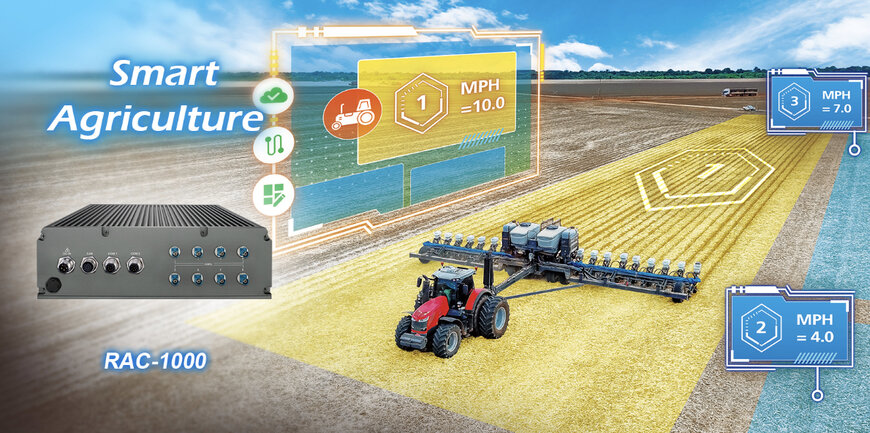
Application Area: Precision Farming
Industry Sector: Autonomous Agricultural Machinery and Embedded Computing
The modern agricultural sector faces a critical transition toward automation and precision farming to address persistent labor shortages and rising food production demands. In Canada, public-private initiatives such as the Canadian Agri-Food Automation and Intelligence Network actively accelerate the commercialization of intelligent farming machinery. Within this landscape, a Canadian agricultural technology developer sought to scale its autonomous navigation platform designed to convert heavy-duty farm equipment into self-driving units.
Technical and Operational Challenges
Deploying computing hardware onto agricultural machinery introduces severe environmental and computational hurdles. Tractors and tillage tools operate in hostile outdoor conditions characterized by high levels of dust, moisture, intense mechanical vibrations, and wide ambient temperature fluctuations. Furthermore, autonomous navigation requires real-time sensor fusion—combining data from LiDAR, GPS units, and multiple high-resolution cameras—to generate a continuous digital twin of the field. Processing these high-bandwidth inputs demands ultra-low-latency edge computing architecture capable of executing split-second path planning and machine control without dependency on continuous cloud connectivity. Additionally, remote farm locations often experience unstable wireless signal coverage, necessitating modular expansion slots for cellular, GPS, and Wi-Fi communication modules.
Technical Solution Selection
To satisfy these operational demands, the company integrated the Vecow RAC-1000 rugged edge computing platform into its autonomous navigation kits. Powered by the NVIDIA AGX Orin processor, the RAC-1000 delivers high-performance Edge AI capabilities required for real-time sensor processing and autonomous decision-making. The platform holds an IP67 rating and complies with MIL-STD-810G and EN50155 standards, ensuring structural and functional reliability across extreme operating temperatures ranging from -25°C to 70°C. For visual perception, the system incorporates up to eight Fakra-Z connectors supporting GMSL2 automotive cameras, providing full 360-degree coverage. Modular communication and custom software integration are achieved via PCIe Gen 3 x8 and M.2 expansion slots, paired with six antenna connectors for multi-band wireless links including 5G, LTE, and GPS.
Deployment and System Integration
In February 2024, the enterprise received a financial grant from the Canadian Agri-Food Automation and Intelligence Network to expedite the deployment of its autonomous farm equipment. The engineering team partnered with Versatile, a manufacturer of articulated four-wheel-drive tractors, to embed the computing platform directly into the vehicle architecture. Through the tractor's CANbus interface, the system gained complete control over core mechanical functions, including steering, propulsion, and hydraulic systems. Field validations conducted across challenging topographies, such as agricultural lands in Saskatchewan, verified the platform's capacity to execute complex maneuvers including land rolling, vertical tillage, and fertilizer distribution.
Operational Impact and Results
The implementation of the rugged edge computing architecture resolved key operational bottlenecks in autonomous field execution. By processing multi-camera and LiDAR data locally on the vehicle, the system achieved autonomous guidance and obstacle avoidance without human intervention. The integration of 360-degree GMSL2 camera feeds enabled remote operators to monitor machinery status safely through mobile applications. Consequently, the technology mitigates labor deficit impacts while maintaining continuous, high-precision performance across intensive agricultural cycles.
Edited by Sucithra Mani, Induportals editor – adapted by AI.
www.vecow.com
